Mesa Verde National Park, Colorado

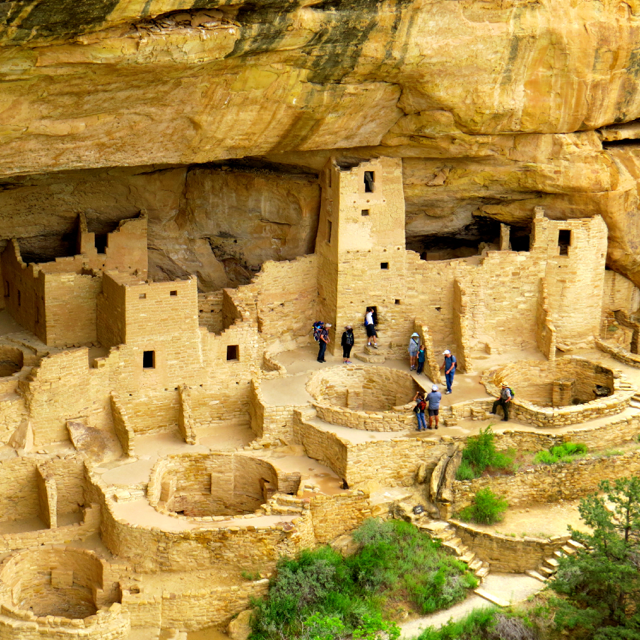
Cliff  Palace, one of the dwellings you can visit at this park.

Cliff Palace, one of the dwellings you can visit at this park.

Mesa Verde National Park is one of the parks I have always wanted to visit. When you have anticipated something for so long there is always a possibility one will be disappointed but the park was a wonder and fulfilled all my expectations and more. For one thing Mesa Verde is not just one large ruin to be visited like I imagined. The mesas are a huge complex of many different types of cliff dwellings as well as the type of architecture that came before the cliff dwellings. You leave there with a much better understanding of how this civilization developed.  There are still many mysteries that archeologists are trying to unravel and some things that we will never know the answers to. Many different tribes still visit and hold ceremonies here because it was the home of their ancestors. 

Another view of Long House

Another view of Long House

The park contains over 600 cliff dwellings and over 4,500 archeological sites with only a fraction open to the public but there is still so much to see and do at the park. To visit Balcony House, Cliff Palace and Long House you must join a ranger guided program. The tours are somewhat strenuous, you have to descend from the mesa top usually climb several ladders and in one case climb through a narrow 12 foot tunnel at Balcony House. Because of my bad knee that was the one tour I missed.

Climbing up after visiting the cliff dwelling.

Climbing up after visiting the cliff dwelling.

There are also a number of self guided sites like Spruce Tree House (one of my favorites!), Step House and Badger House Community. Badger House community shows how the building styles evolved over six hundred years from pit houses to cliff dwellings.
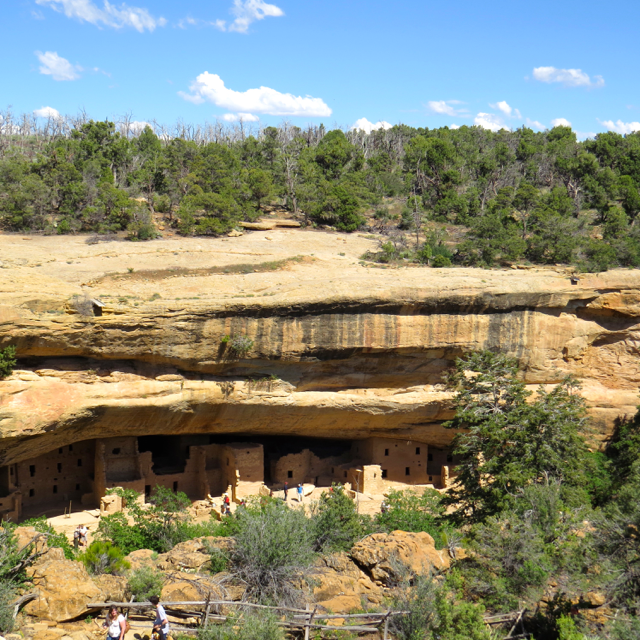
Imagine dozens of people climbing up and down those sandstone walls to get to the fields above.

Imagine dozens of people climbing up and down those sandstone walls to get to the fields above.

My favorite tour was Long House, mostly because the guide was so passionate about the place. At the end of the tour you left with a real feeling for the past and the lives that lived there. One of the main differences today is that the top of the mesas are forested, when the cliff dwellings were occupied the top of the mesas were all farm land. The people used hand holds in the sand stone to climb back and forth from the dwellings to the fields, it was quite high and I tried to imagine young children and also older people climbing up and down the walls. I wouldn’t have made a good ancestral pueblo Mom, I would be a nervous wreck about the children climbing. One of the theories archeologists have about why the people began to build cliff dwellings was that as the population grew they needed more farmland so they began to build their homes in the cliffs to free up more land. The older dwellings of these people are on top of the mesas and are similar to the structures modern Hopi’s make.
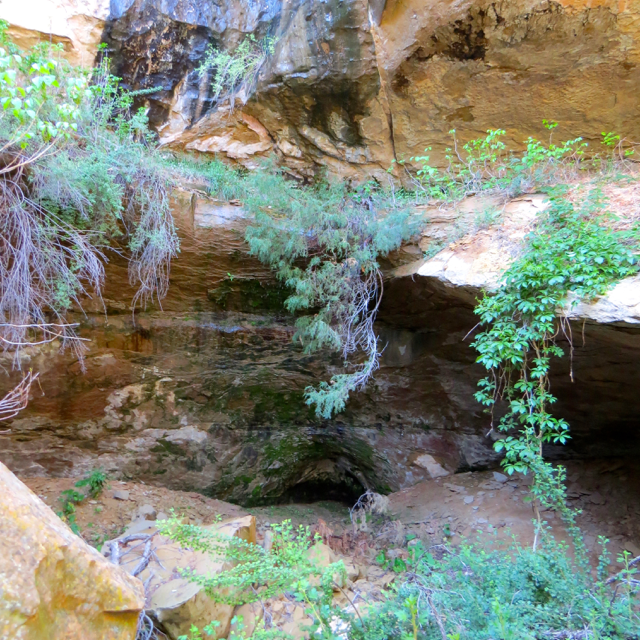
Green area in back of Long House where water is seeping in.

Green area in back of Long House where water is seeping in.

Our guide to the Long House showed us how water would seep from the sandstone at the back of the cave and the people built cisterns to hold the water. Like Cliff Palace, Long house also had several towers built with ancient paintings inside so we know they liked to decorate their dwellings. The fact that a painting would last that long is a testament to the dry desert air of this area.
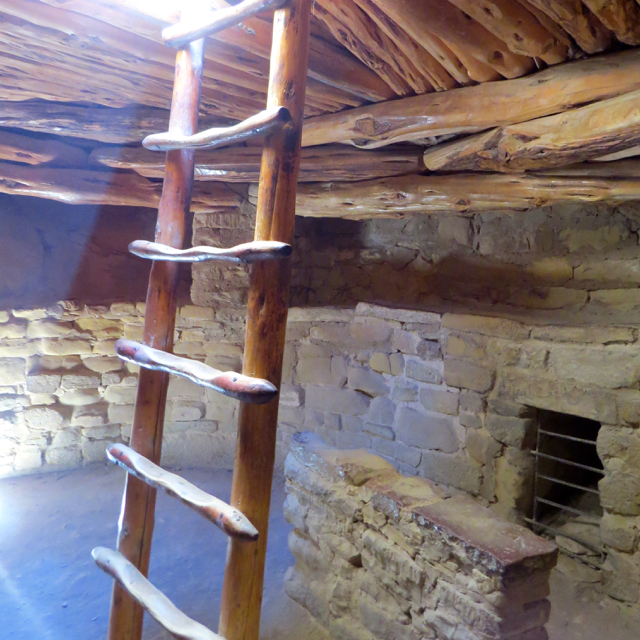
Inside of a kiva.

Inside of a kiva.

One part of the structures that fascinated me was the kivas. These are round underground rooms within the cliff dwellings. Although most of the kiva’s here are open, normally they would have a closed roof. You would enter the kiva from a ladder in the top. I climbed down into one at Spruce Tree House. I sat quietly and watched the light filter down from the top and tried to imagine the people sitting here many hundreds of years before, doing whatever their routine was in daily life.

Looking down on an open Kiva one can see the fire pit, ventilation hole and shield. The small hole towards the left is called a sipapu and it is believed to be a ritual entrance from another world.

Looking down on an open Kiva one can see the fire pit, ventilation hole and shield. The small hole towards the left is called a sipapu and it is believed to be a ritual entrance from another world.

Would there be a fire lit in the center of the kiva? Each Kiva was also equipped with a ventilation shaft which had an air deflector, when a fire was burning it would draw air from the shaft and the ventilation shield would keep the air from blowing directly into the fire. The smoke would leave from the same hole you climbed down into the kiva with. I imagine the kiva to be a cozy place in the cold winter months.
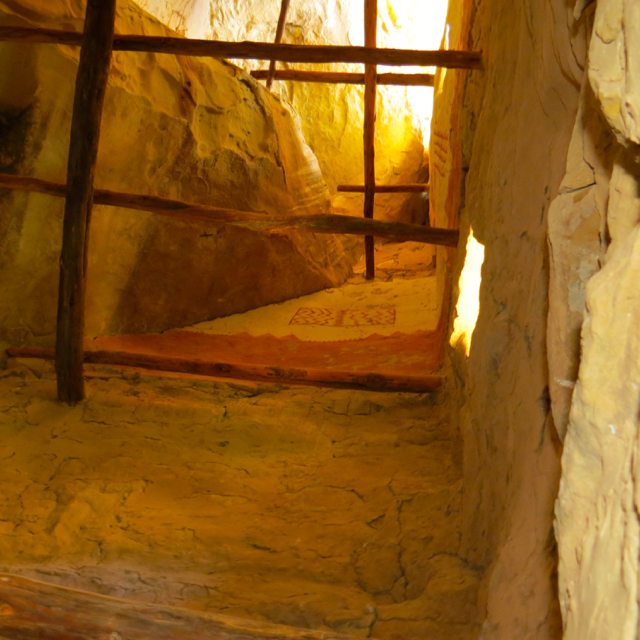
Looking up into one of the towers at Cliff Palace. Can you see the painting?

Looking up into one of the towers at Cliff Palace. Can you see the painting?

Even though I spent a week at Mesa Verde, it still wasn’t enough – there was so much more to learn. The site has an excellent Archeological Museum with beautiful examples of pottery, basketry, tools and clothing. Today, many native people including the Hopi, Navaho, Zuni and Acoma regard these structures as home of their ancestors. Each group has elements of this culture in their cultures today. The traditions are living and continue on for these people and they are gracious to share their culture with us.
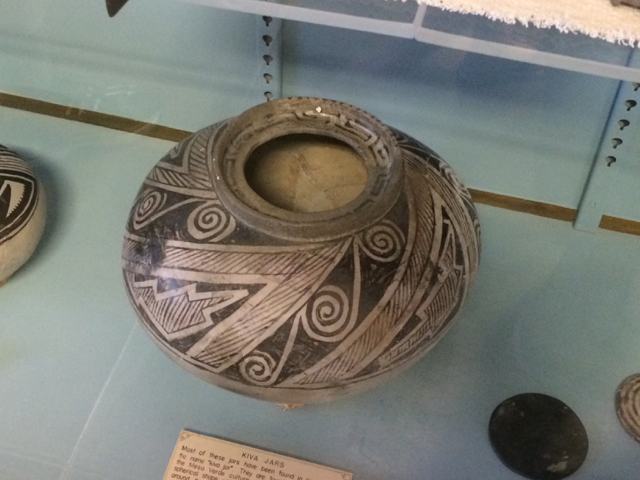
An example of the pottery found at the site.

An example of the pottery found at the site.

Posted in Desert, Historic Places, Rockies | Tagged , , , , , | 2 Comments

I Meet the Real Kokopelli

Monument Valley

Monument Valley

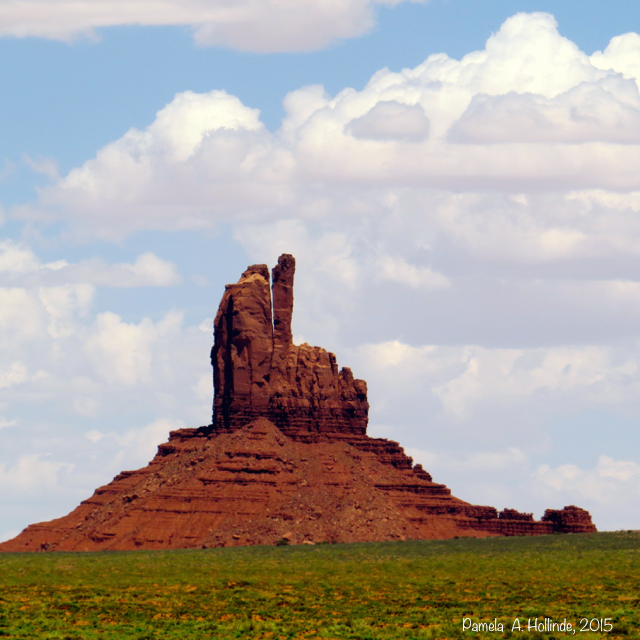
One of the monoliths

One of the monoliths

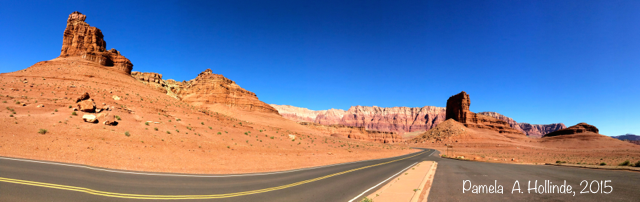
After leaving Lee’s Ferry I decided on a round about way to Mesa Verde National Park. I drove through Monument Valley which is in both Arizona and Utah on the Navaho reservation.  If you have seen an old western film you have probably seen Monument Valley, it is a trademark of the west. It isn’t really a valley but a broad flat plain where giant rock monoliths rise from the floor of the desert. These monoliths are that bright vermillion red that dazzles the eyes.

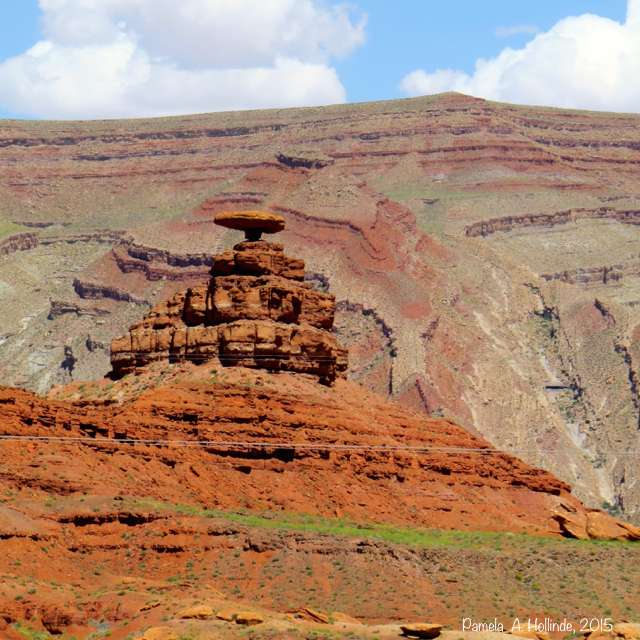
Can you see the Mexican Hat?

Can you see the Mexican Hat?

On the way, I went through a small town named Mexican Hat, named for the rock formation just outside the town. The San Juan River passes through here and Mexican Hat is a stop off for rafters on their way to Lake Powell.

I camped at Sand Island which is along the San Juan River as well. I knew the campground had some petroglyphs that I wanted to check out. What I didn’t know was that this campground is a big staging area for people going on rafting trips.

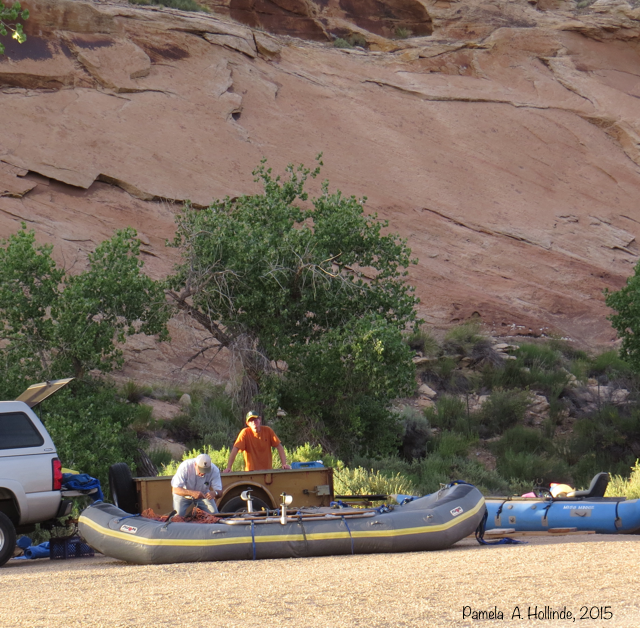
two guys preparing their equipment.

two guys preparing their equipment.

I had seen companies take people on rafting trips through the Grand Canyon but I didn’t realize that many people do it without those companies and just use their own equipment and a river guide. It was fun watching people get their rafts ready for the big trip. They float the San Juan from Sand Island all the way to Lake Powell, the trip takes about a week.

I met a family who were about to take the trip. I was amazed at all the gear they had to bring. When they pulled up it was like the clown trick in the circus where 20 clowns get out of a Volkswagen. Four people, a raft, inflatable kayaks, and just a staggering amount of gear came out of their car. All they needed for a week had to go in the raft. Tents, sleeping bags, coolers, food,a toilet, clothes and drink all packed in waterproof bags.

Happy Rafters!

Happy Rafters!

Their excitement rubbed off on me, I was ready to get a raft and try it. When it was launch time I went down and photographed the whole family. The kids each got to paddle their own inflatable kayak, and the adults manned the rafts. I learned there is even a taxi service which drives your car to the place where you will end up in a week. I was so jealous, I wanted to throw Tangerine Dream (name of my kayak) into the water and beg them to take me with them. Oh well, that will be an adventure for another day.

The popular Kokopelli

The popular Kokopelli

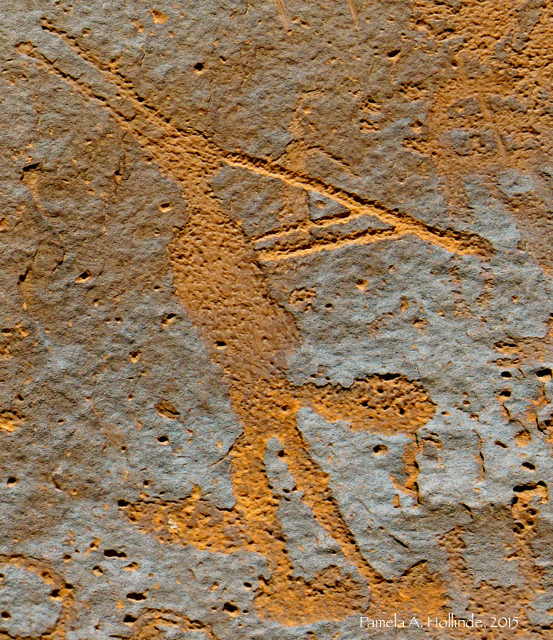
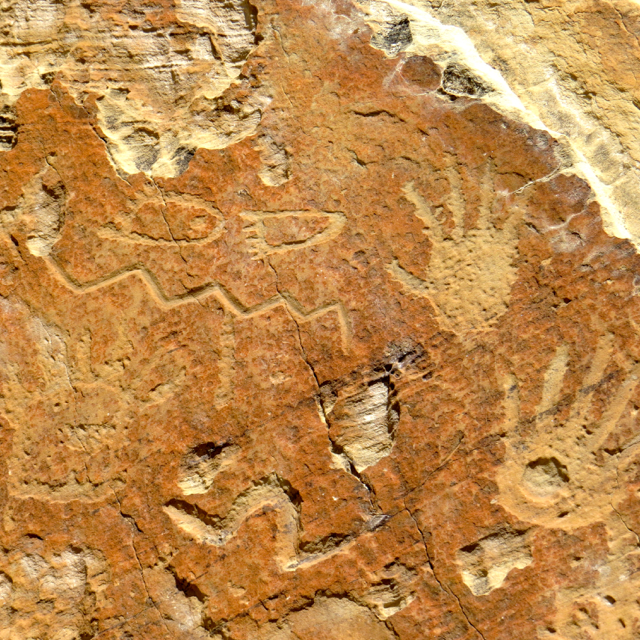
The next day I tore myself away from rafting and went to check out the petroglyphs at the campsite. It was here I met the real Kokopelli. The symbol for Kokopelli is all over the southwest. He is celebrated as a God of Fertility and Rain by some of the Native tribes in the area. Now he has become a popular symbol of creativity and you see his emasculated form everywhere. The popular Kokopelli is depicted with antennae, playing a flute.  The Sand Island petroglyphs included a figure of Kokopelli with the antennae and the flute but with one important difference, you can see how well endowed he is. This Kokopelli is a down to earth guy, fertilizing the earth with his huge penis. Akin to the Greek God of Pan, he plays his flute and is also known as a trickster. I think the trick is on us. I’m glad I got to meet him.

Petroglyph of the real Kokopelli

Petroglyph of the real Kokopelli

Posted in Desert, Historic Places, Rivers | Tagged , , , , | 8 Comments

A Mighty River

A map of the Colorado River

A map of the Colorado River

I first met the Colorado River many years ago when my son and I were traveling across the U.S. We had just spent a few days at the Grand Canyon where I learned that the tiny strip of silver water that I had glimpsed at the bottom of the canyon was the Colorado River and was responsible for carving out this amazing wonder. From our view point at the top the river was unreal, just a slip of glass, reflecting the light.

You can just catch a little glimpse of the river from the top of the canyon.

You can just catch a little glimpse of the river from the top of the canyon.

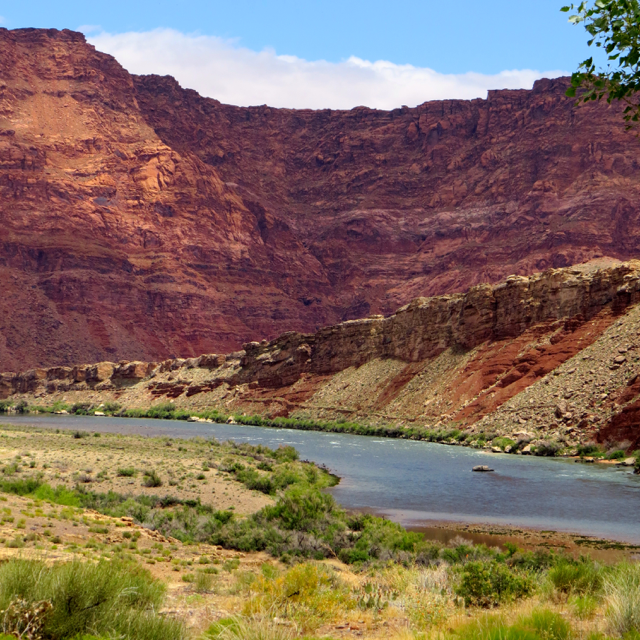
We left the canyon and were making our way to Bryce Canyon National Park. It was 97 degrees by noon and our car had no air conditioning. We had all the windows opened but the hot air was no comfort as it whipped across our faces. I saw a sign for Lee’s Ferry and decided to stop there in search of shade and rest. We passed through an amazing landscape to get there, huge red rock carved into castles and canyons. Each turn presented another amazing structure and the light made everything shine in a bright vermillion shade of red.  At the end of the road was a beach called Paria beach and a river, the clearest river, cold and clean rushing by the beach. It was the Colorado river on it’s way to the Grand Canyon.

The scenery driving into the river is stunning!

The scenery driving into the river is stunning!

Jack and I spent a wonderful hour wading and exploring down by the cool river. We watched laden rafts swirl by with people on their way to adventure. Fly fisherman were having luck at catching trout. I felt this was a magical place and vowed to return someday and camp here.

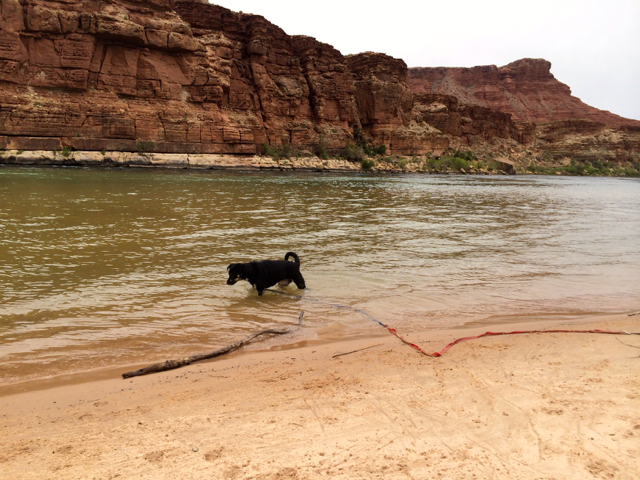
Maya swimming at the beach.

Maya swimming at the beach.

So it was that I returned sixteen years later and decided to spend Memorial day weekend at Lee’s Ferry. I was in awe of the red cliffs as I drove in. I set up quickly and took Maya down to the beach. Now that I’ve spent a few months in the desert I understand the power of an oasis. In the desert you can smell water, it’s like a fresh clean promise. I sat on the beach with my eyes closed smelling and listening to the rushing water. It was so cold, there were pins and needles in my feet as I waded at the edge. This didn’t seem to bother Maya as she plunged in to finally get cool. The fisherman were still there and so were the rafts headed for the Grand Canyon. I was thrilled that this place hadn’t changed much in sixteen years, it is one of the few places where you can access the Colorado River. Much of the river is in a deep canyon which makes it difficult to get to.

The beach is like a garden, filled with flowering plants, and interesting driftwood and rocks.

The beach is like a garden, filled with flowering plants, and interesting driftwood and rocks.

I learned that this became a big problem for pioneer families that came west. There were only two places you could cross the Colorado River, Lee’s Ferry in Northeast Arizona or way down in Yuma, Arizona which is in the Southwest corner of the state. The Yuma crossing was much easier but very inconvenient since many of the pioneers were Mormons headed to Utah. They took the risk of trying to cross at Lee’s Ferry. The wagons had to descend a steep hill of rocks called “The Spine”.  Wagons then boarded a raft that was at the mercy of the currents as it tried to make it’s way to the other side. Many wagons, rafts and people were lost in this process. In those days the Colorado River was much wilder, it didn’t have man-made dams to slow it down. It’s hard to imagine what the untamed Colorado was like, but then again that wild river did carve out the Grand Canyon.

The hill to the right that is filled with lumpy rocks was called, The Spine. It took days to get all the wagons down.

The hill to the right that is filled with lumpy rocks was called, The Spine. It took days to get all the wagons down.

I checked Wikipedia for a few Colorado River facts. It is 1,450 miles long and drains into the Gulf of California, although it hasn’t had enough water to reach the Gulf since the 1960’s. Why? Because the Mighty Colorado now provides water to seven U.S. States and two in Mexico and they are among the most arid states in the land. Hoover Dam provides enough hydro-electric power to light up Las Vegas and Glen Canyon Dam sends it’s power to Arizona. Ninety percent of the river’s water is used up before it arrives in Mexico. The Imperial dam deflects the remaining water to the Imperial Valley in California for agriculture. Phoenix, Tucson and Las Vegas all depend on the river for water. I even learned why the river is so cold at Lee’s Ferry, because the Glen Canyon Dam releases the water from the bottom of the reservoir where it is a consistent 48 degrees. When the Colorado was wild it would warm up to the seventies in the summer!

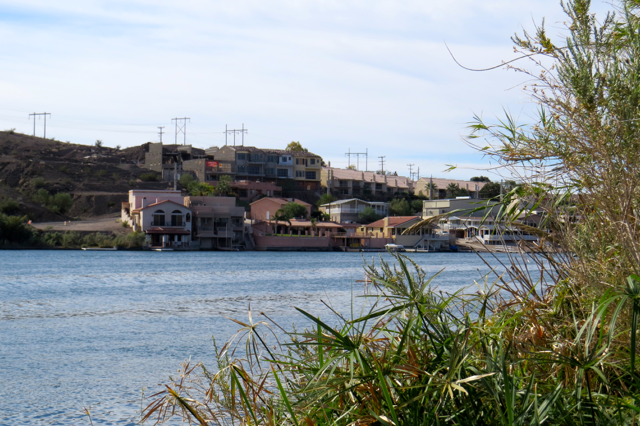
Lower Colorado River below Parker Dam. Houses and resorts line the river on both sides.

Lower Colorado River below Parker Dam. Houses and resorts line the river on both sides.

I camped on the lower Colorado, below Parker Dam on the Arizona, California border in the Fall of last year; it was a very different river. Beautifully clear, it was warm enough to swim in. The flow was gentle enough to paddle my kayak up river. It was truly an oasis for this community, all the houses were along the river and everyone had some sort of boat. It is an important stop for migrating birds and a source of water for the wild burros who live in that area. Even though the temperature in the area was in the nineties every day Maya and I didn’t mind because we could play in the river.

This part of the river is very important for migratory birds.

This part of the river is very important for migratory birds.

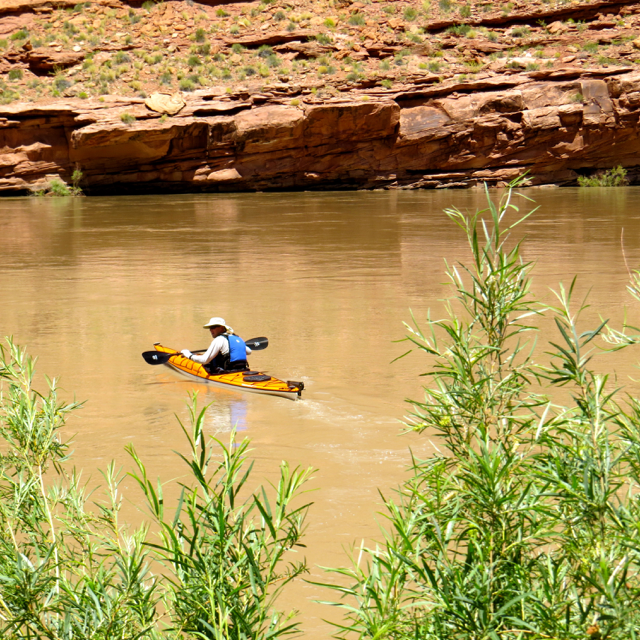
After we camped at Lee’s Ferry I found another campsite right on the Colorado river by accident. The Colorado runs along the border of Arches national park just Northeast of Moab, Utah. There are a string of beautiful BLM campsites along the river. We found a great spot for six dollars a night, right along the river. Here the Colorado changed character again. The color of the river was red, like all the rocks in the area. The flow was very strong and the river was quite high -rangers advised people not to kayak. I did see quite a few rafters going down the river and since it was so hot I was dying to swim and kayak but I do have a respect for the power of the river. I solved the swimming problem by tying a tube to the shore, that way I

Greg departing in his Kayak. Notice the color of the water here.

Greg departing in his Kayak. Notice the color of the water here.

wasn’t swept away by the current. The water was cool but not that pins and needles cold it was in Lee’s Ferry. I tried to kayak upstream but it was impossible. Iwas frustrated because I wanted an opportunity to ride the river. My chance finally came in the form of Greg from Durango. He was in town for the day and had brought his Kayak with him because this was a new part of the river he hadn’t tried yet. He was driving by and noticed my campsite was a great place to launch so he asked me if he could launch his boat there. I agreed and we got to chatting – I told him I hadn’t had a chance to try the river because I had no ride home. He offered to drive me and the kayak a few miles upstream so I could paddle back to the campsite. It was the ride of my life! I can only compare it to riding a big fast horse at a gallop. You feel the animal’s strength and energy under you and know that the sense of control that you have is just an illusion. Disaster can happen at any moment. Disaster didn’t happen, although I almost shot past the campsite and had to paddle like a madwoman to make it in. I am completely in love with this river and feel I have come to know some of it’s many moods. I have a new goal, someday I want to ride a raft down the mighty Colorado river.

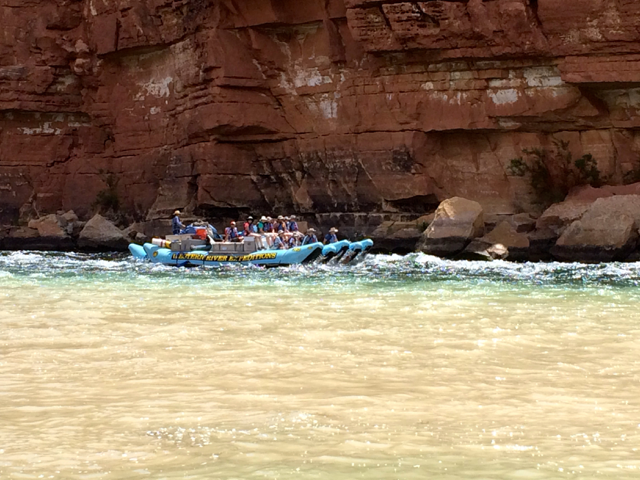
Rafters on their way through the Grand Canyon. The trip takes about 22 days.

Rafters on their way through the Grand Canyon. The trip takes about 22 days.

Posted in Desert, Rivers | Tagged , , , , | 11 Comments

Paso´por aquí, I passed by here…

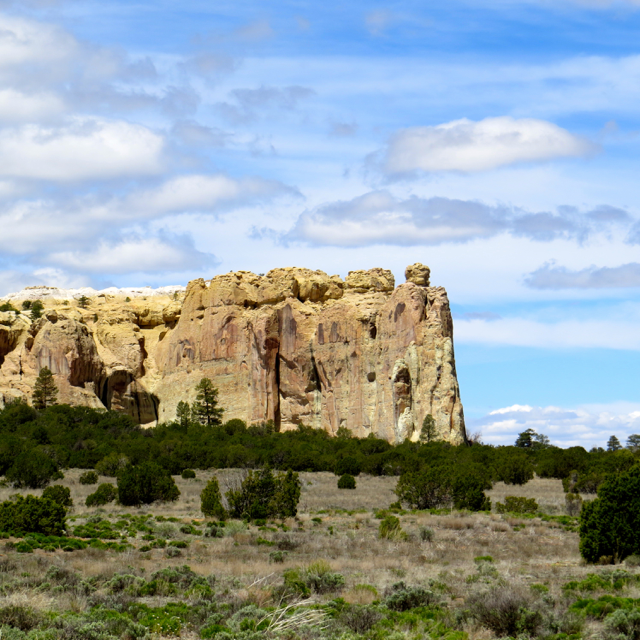
El Morrow National Monument

El Morrow National Monument

One of the most moving places I have visited thus far is El Morro National Monument in New Mexico. Here, under a towering sandstone bluff you will find a small pool of water, an oasis in the desert. Etched into the wall around the pool are carvings in the sandstone from Native Americans, Spanish Explorers, American Military and pioneers. For over a thousand years this was a vital stop to get water in the desert and as the travelers stopped they left their mark in order to simply say, I have passed this way.

Examples of petroglyphs found in El Morro, I like the bear paws.

Examples of petroglyphs found in El Morro, I like the bear paws.

What makes this experience so special for the visitor today is that archaeologists have tracked down the stories of many of the people who signed their names. Spanish Conquistadors who brought priests and settlers into New Spain in hopes of gold and riches. After the land became American territory, many military brigades passed through on their way to Arizona and California, including the famous Camel Brigade the army experimented with in the 1850 to see if camels could cross the desert lands any better than the soldiers on horseback. Gilmer Breckinridge, a soldier in charge of 25 camels, signed his name as they passed through the area. One of my favorite inscriptions came from a young pioneer girl, Sara Fox.

Oasis at the base of the bluff.

Oasis at the base of the bluff.

Very few women signed the wall, but she did, showing something of her later spirit. After they left El Morro her wagon train was attacked, her stepfather killed and she was wounded by an arrow. Sara recovered and settled in California, living to be almost seventy years old. I would have loved to have talked to her about her experiences. Some of the information that I have found on her states that she became a teacher and was also an artist, working in oil paint. No wonder I feel such a connection with her.

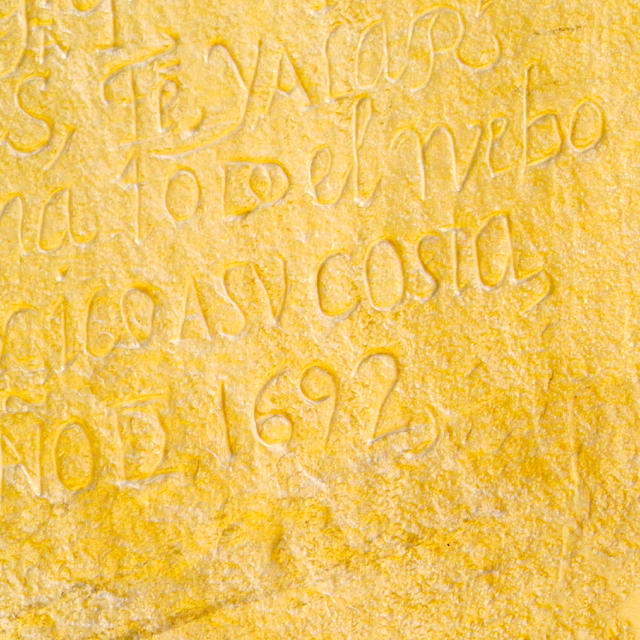
Spanish inscription from 1692

Spanish inscription from 1692

After one passes the pool and the inscription wall there is a trail that goes up to the top of El Morro. Looking up from the bottom I didn’t think I could make it. The high altitude has  been making me short of breath, I have a bad back and knees and I’m afraid of heights! Curiosity got the better of me, there was an ancient ruin on the top and I really wanted to see it. Maya is always ready for an adventure so we tried and made it! The climb was not too bad and when you reached the top it was exhilarating. The scary part was that the trail continued along the bare rock on top of El Morrow for about another half mile. There was a box canyon in the center so there were drop offs on either side of the trail and it was quite windy. I kept thinking about all the different types of feet that passed on this very well worn trail.

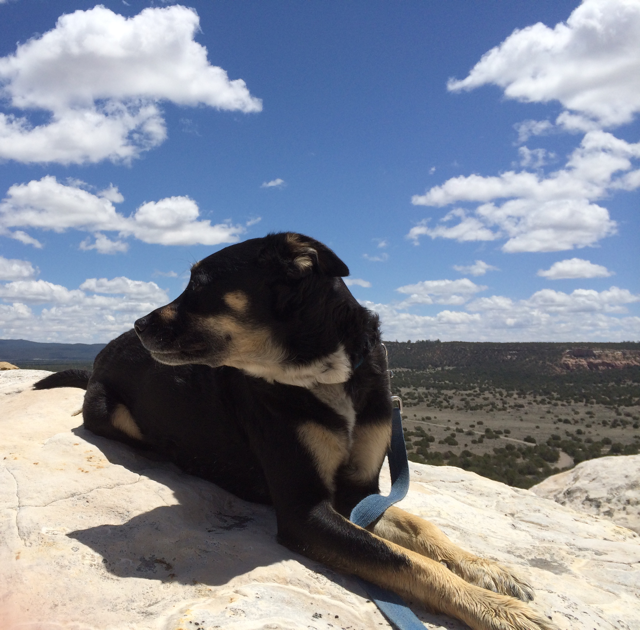
Maya taking in the view at the top of El Morro

Maya taking in the view at the top of El Morro

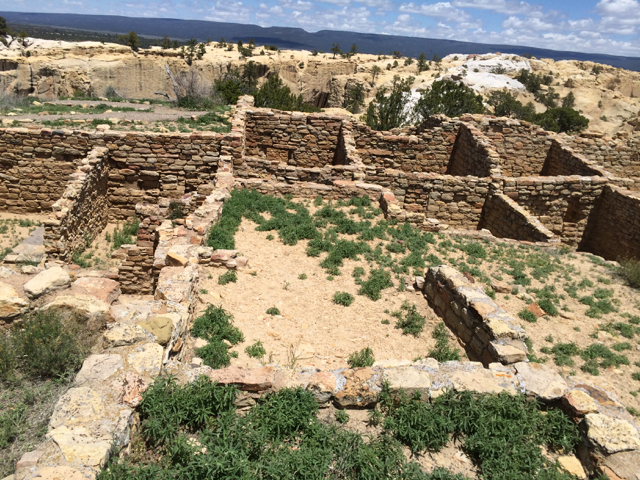
Maya and I finally arrived at Atsinna – “place of writings on the rock” which is the name the Zuñi call the ancient village. It is not a cliff dwelling but sits on top of the mesa with an impressive view all around. I asked one of the rangers who is also a Zuñi if protection was the only reason for building there. He explained that protection was only part of the reason, the box canyon was a perfect way to not only spot large game animals but to also trap them. Once a herd of elk or mule deer entered the canyon, hunters were able to quickly close off the narrow entrance with brush in order to kill the animals easily. It is estimated that between thousand to fifteen hundred people lived in this village and that is a lot of mouths to feed in such an arid land so native people used the landscape to their advantage.

View of Atsinna at the top of El Morrow

View of Atsinna at the top of El Morrow

Maya and I took some other interesting hikes in El Malpais National Monument which is about 40 miles away from El Morro. El Malpais means the bad country in Spanish and this is one of the areas of great volcanic activity in New Mexico. Lava fields spread out for miles and only stop when they approach huge sandstone cliffs. I was disappointed at first with the lava fields because they are covered with plants, I was expecting something like the fresh lava in Hawaii. But the area had many fascinating features so I wasn’t disappointed for long. One of the coolest things was the lava tubes which went on for miles and miles, they are hollow inside and form caves when they collapse. I visited one that had ice formations inside even in the summer.

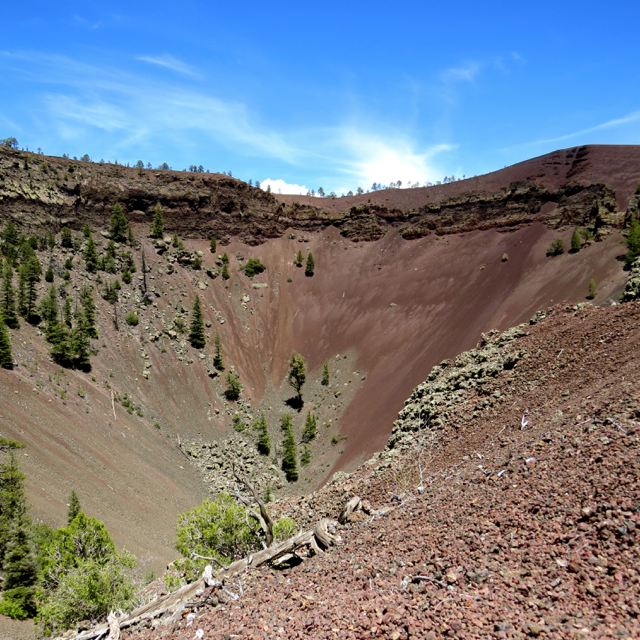
An extinct volcano cone, many can be found in this area.

An extinct volcano cone, many can be found in this area.

It was on a private ranch and the owners have stories of the old days when they used a small one near the inn to keep the beer cold. This family has passed the land down through generations, someone was farsighted enough not to sell it to the national park because it was a unique tourist attraction. They have an interesting collection of artifacts they have gathered over the years, a hodgepodge of natural, Native American and old west objects. I was glad to be one of their “tourists”, the caves in the National Park were a several mile hike in and I don’t like hiking alone especially when you are in cougar country. There had been a sighting in the area the day before so I was a little spooked out.

Inside the lava tube

Inside the lava tube

I loved New Mexico but was snowed on again the day before I left El Morro so instead of heading farther North as originally planned I headed southwest, back to Arizona to warm up and camp somewhere I have been wanting to camp since I first saw it 18 years ago. I tell you where it is next post.

Posted in Desert, Historic Places, New Mexico | Tagged , , , , | 5 Comments

New Mexico

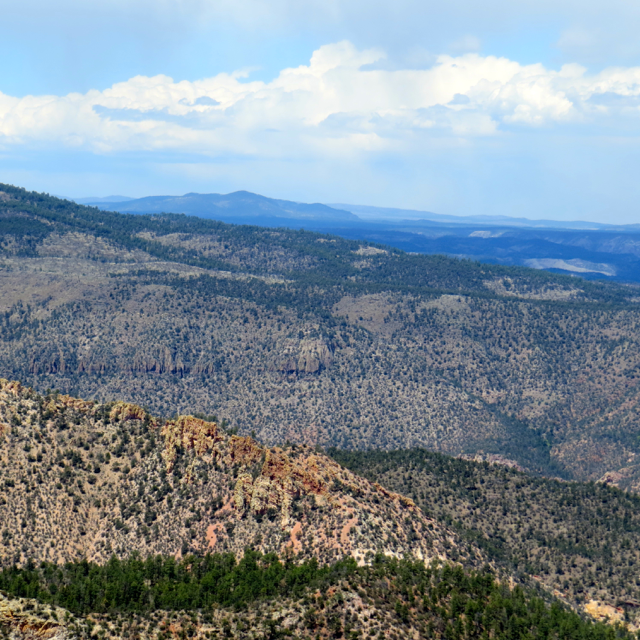
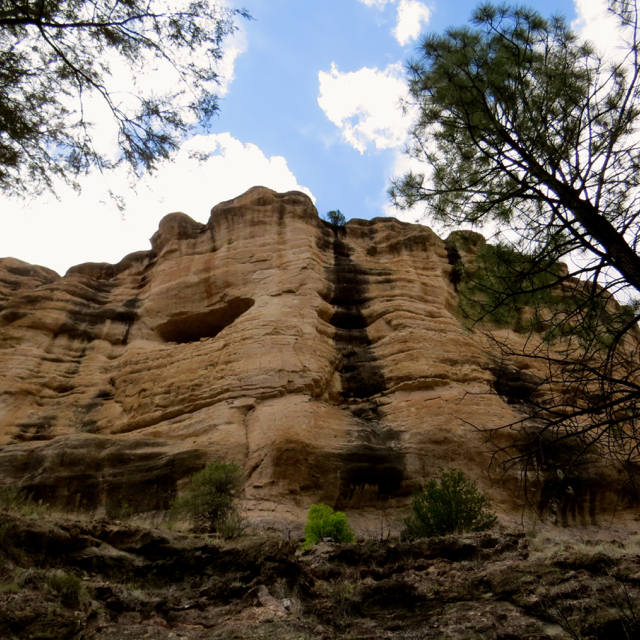
Mountains in the Gila National Forest

Mountains in the Gila National Forest

My son Jack and I zipped through New Mexico on I-40 about thirteen years ago. We camped a few nights near Albuquerque and I was fascinated by the state and vowed I would visit again. What I failed to realize on our quick trip through is that New Mexico is a very mountainous state and when you are camping, every thousand feet you rise, the temperature falls.

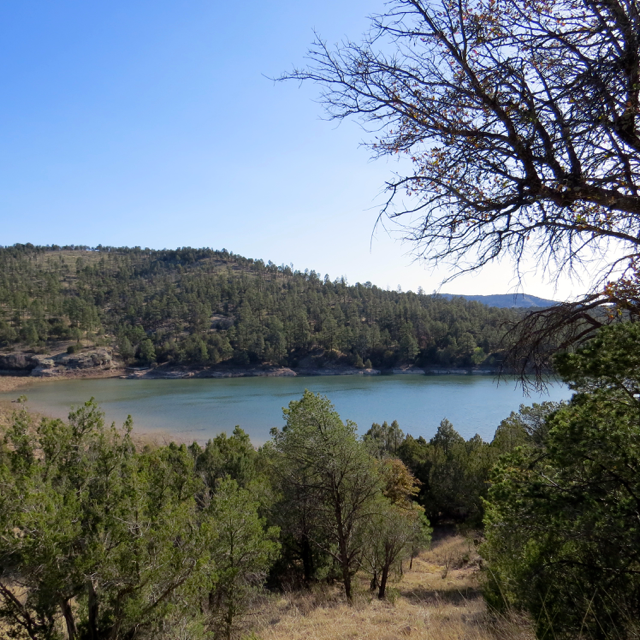
Lake Roberts

Lake Roberts

My first stop was the Gila Cliff Dwellings, in the southwestern part of the state. I found a great campsite on a little lake called Lake Roberts. I set up camp quickly because I still had my Arizona shorts and sleeveless shirt on and it was about 55 degrees. That night was really cold; I’m set up for cold weather, I have a heater (which I don’t run while I’m sleeping), a warm sleeping bag and plenty of extra blankets. The only time cold weather is really painful is in the morning when you get up to put the coffee on and realize there is a skim of ice in the dog’s water bowl! I have wakened to snow twice since I have been here! But spring is arriving to New Mexico and during the days when the sun shines it’s usually between 65 and 70, great hiking weather, so Maya and I have adjusted.

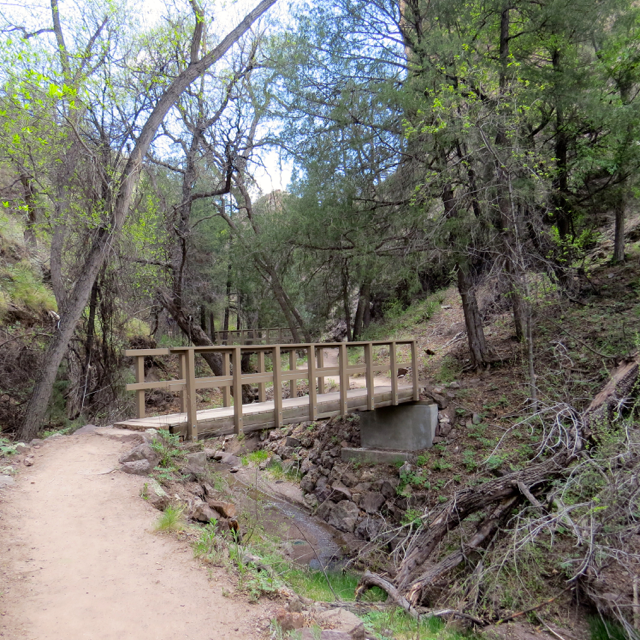
It was a pretty hike up to the cliff dwellings.

It was a pretty hike up to the cliff dwellings.

The Gila Cliff Dwellings are the second ancient homes I have visited. They were different from the ones I visited in Arizona that were built by the Salado people. For one thing there is water close at hand.When you hike up to the cliffs you pass through a lovely wooded area with a stream flowing through it.

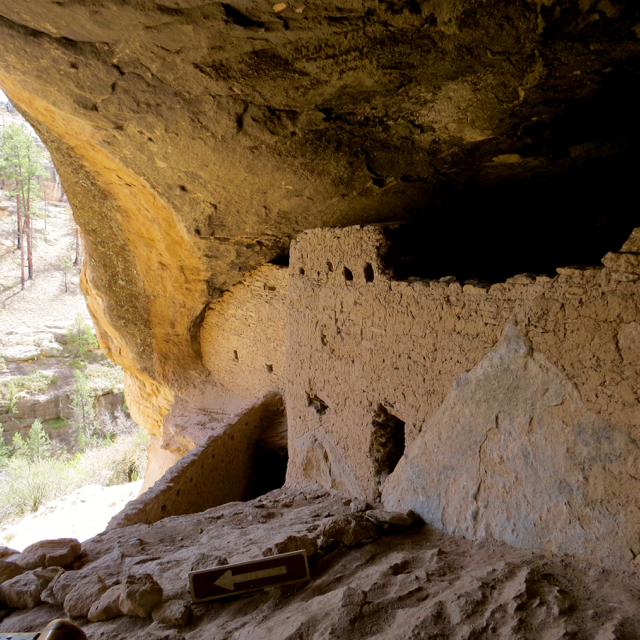
These homes were built by the Mogollon people in about 1275. The dwellings themselves are much larger and more elaborate than the Arizona ones, they have many rooms. The builders also have borrowed some architectural elements from native people that lived farther north. It is believed that a great deal of trade went on between natives of Mexico, Arizona and New Mexico. Macaw feathers and shells from farther south were found. Evidence of Apache hunter-gathers were found in the area and the Mimbres people lived to the Southeast of the cliff dwellings. As I was touring one of the park rangers brought up a fascinating point about these dwellings, she said

This Window is an example of archetecture used by natives farther north.

This Window is an example of architecture used by natives farther north.

“It is often what archeologists don’t find that is also significant.” In this case, archeologists never found any burial sites in the area and believe this dwelling was abandoned after only one generation. No one knows why, it seems like a perfect spot. Yet in Arizona where the climate seemed harsher, people thrived for hundreds of years. I love history and like to ponder puzzles like this one that seem to have no answer we will ever discover. Did other tribes force them to leave or was it the climate that initiated the move?

This is the front porch of the dwelling.

This is the front porch of the dwelling.

A shot of the interior.

A shot of the interior.

View from below.

View from below.

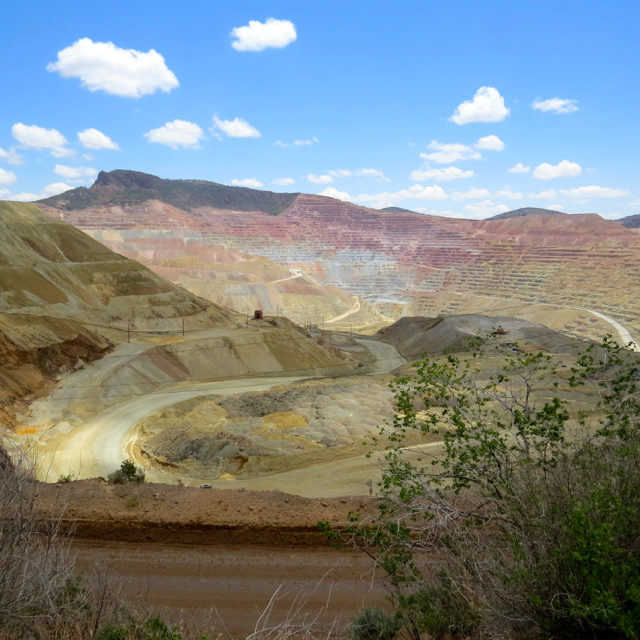
Santa Rita open- pit mine.

Santa Rita open pit mine.

Near by the Cliff Dwellings is a huge open-pit mine in Santa Rita, New Mexico. Native Americans had been using surface copper and turquoise from this area for jewelry. When Americans discovered the ore, mining began in earnest.  The town of Santa Rita which grew up because of mining activities had to be moved when it was found it was sitting atop valuable ore. Today there stands an immense open-pit mine which is really quite beautiful with all the different colored soils and ore.

Datil Well campground where the elk and the antelope play.

Datil Well campground where the elk and the antelope play.

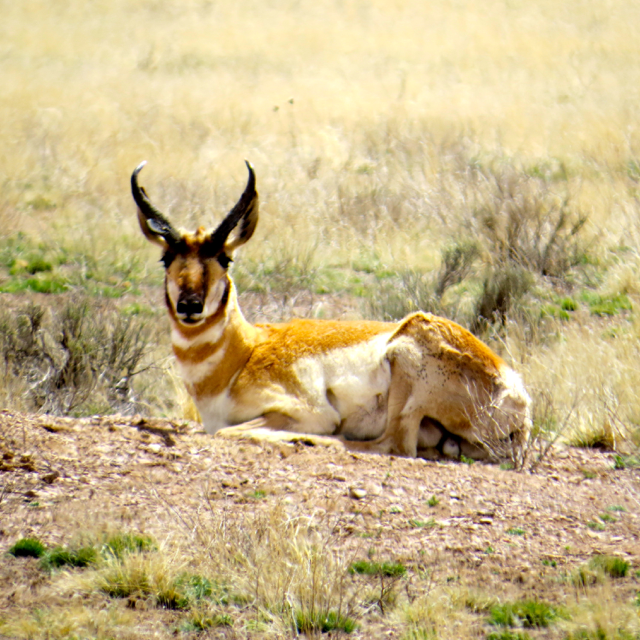
My next stop in New Mexico was north of Gila National forest at the Datil Well Campground. This place was famous for being one of the wells that stockmen would water their herds at. Wells needed to be about ten miles apart, which was about how far a herd could travel in one day.  In Magdalena the cattle and sheep would be loaded on trains to go East to the slaughterhouses. The country hasn’t changed much, it’s still open plains with herds of cattle and horses along with elk and pronghorn antelope grazing under a big sky.

Pronghorn antelope

Pronghorn antelope

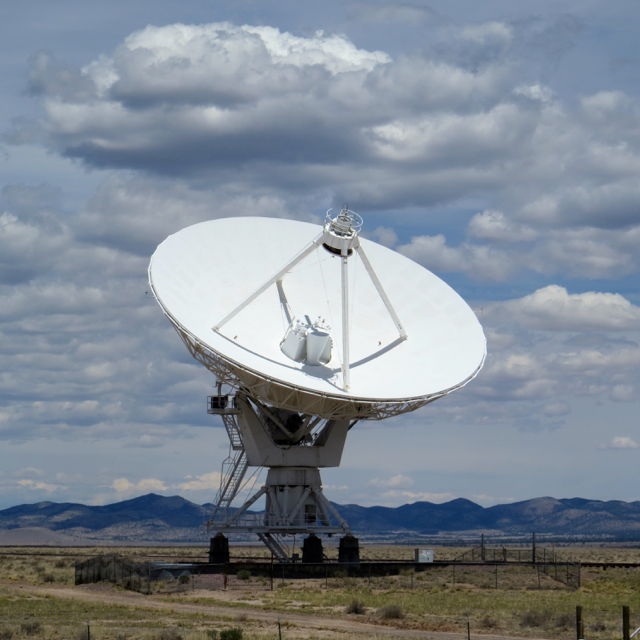
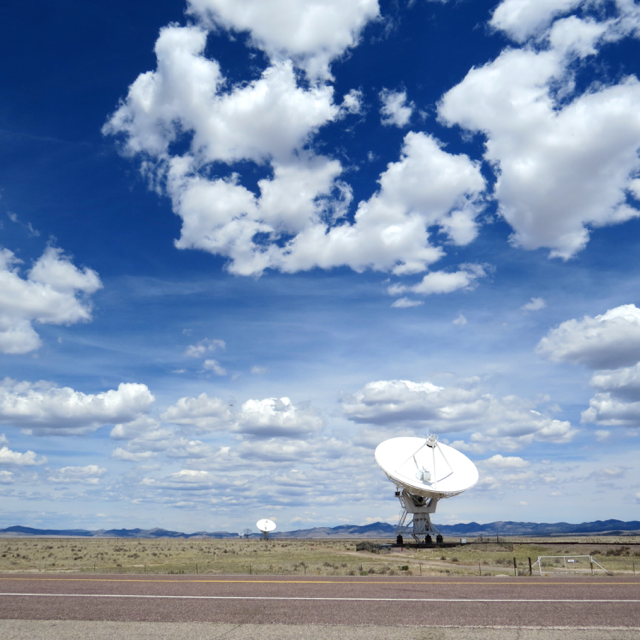
This place is named the Plains of St. Augustin. The plains themselves sit at an elevation of over 7,000 feet and are surrounded by mountains. At one time this was an enormous lake. Now it is the perfect spot for the VLA, or Very Large Array. The VLA is a radio telescope made up of 27 dish shaped receivers which can be moved into different arrangements, the largest being 22 miles long! The receivers work as one very large radio telescope. The facility has a fantastic visitor’s center and a self guided tour. I entered not even knowing that radio waves could be used to make images and left with a very basic knowledge of how this technology is used to study black holes and other galaxies. School children often visit this facility and I wish it wasn’t so remote so that more students could come and see science in action.

Just one of the radio dishes.

Just one of the radio dishes.

I traveled less than 150 miles in this part of New Mexico and experienced a culture from 1276, stock trails from 1800’s to the most advanced technology we have in 2015. Time traveling is sometimes weary business, but definitely worth it! I’m glad I’m discovering more of New Mexico.

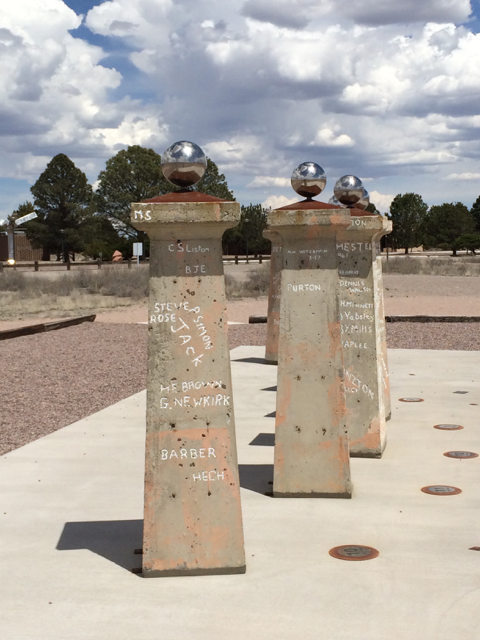
Famous scientist and Nobel Prize winners were invited to sign the posts of the sundial.

Famous scientist and Nobel Prize winners were invited to sign the posts of the sundial.

The visitors center also had a radio sundial.

The visitors center also had a radio sundial.

IMG_5674

In this photo you can see how far apart the dishes are placed.

Posted in Desert, Lakes, mountains, New Mexico | Tagged , , , , , , , | 6 Comments

Theodore Roosevelt Lake, AZ

IMG_5358

A fellow blogger recommended Theodore Roosevelt lake to me. I was looking for relief from the 90 degree weather, a place to kayak and a campsite where Maya could enjoy swimming. In truth, 90 degrees was fine for me but my black, heat absorbing dog was miserable. I had actually thought of making her a white cape and hood that she could wear on our walks – Maya of Arabia! No need for that though once we found this oasis.

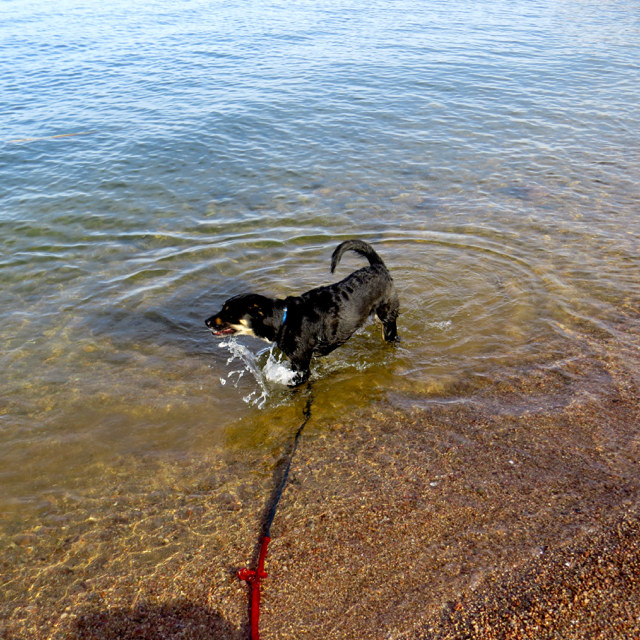
Maya is in Heaven!

Maya is in Heaven!

Our first campsite was called Cholla, and it was an amazing bargain. For three dollars a night you had a campsite with a table under a shelter, fire pit, dumpster, dump station, flush toilets and solar showers. Did I mention the campground was absolutely beautiful? It was located on a cliff overlooking the lake, surrounded by mountains. Everything was in bloom and there were many types of birds to be found including a pesky Gila Woodpecker who insisted on drilling the tin roof of the picnic shelter at dawn every morning! 

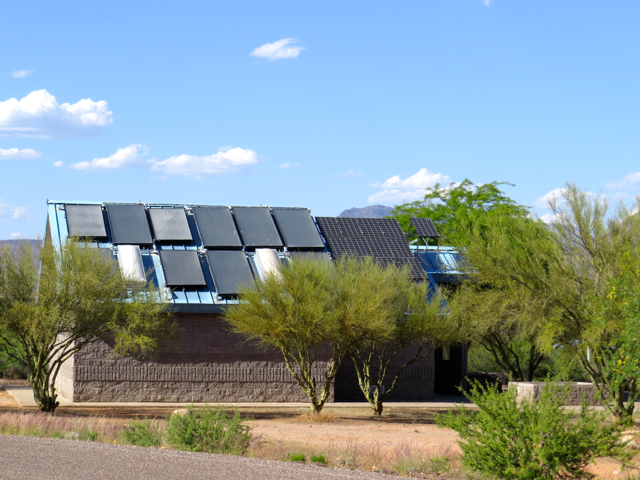
These solar showers were wonderful, i would like to see more National parks invest in these.

These solar showers were wonderful, i would like to see more National parks invest in these.

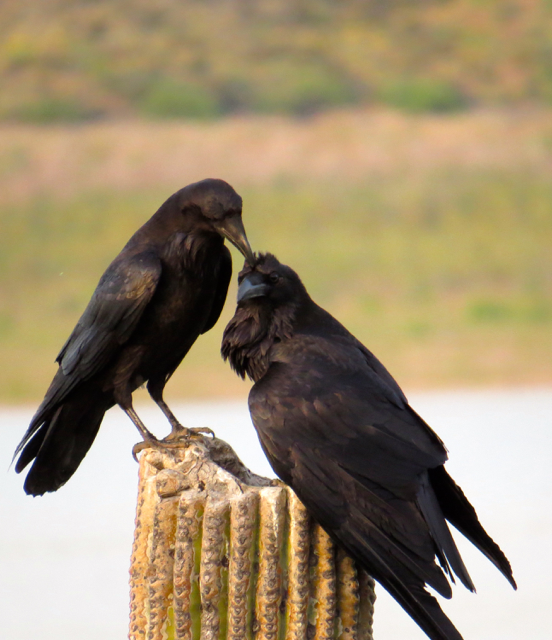
There was a trail down to a small beach where I would take Maya swimming. Two Ravens had built a nest and one day I photographed the pair grooming each other in what looked like a mating ritual. On the other side of the peninsula from where the beach was, there was a dead javelina in the water that had attracted dozens of vultures. It was interesting to see them circle and land on this dead tree by the water and sit all hunched up in their peculiar vulture stance. They did their job and the javelina was soon picked clean.

Raven love.

Raven love.

This Curved Bill Thrasher can't stand all the mush.

This Curved Bill Thrasher can’t stand all the mush.

I made a new friend named Debbie and her little dog Sandy. She helped me catch Maya one day when Maya escaped. Maya is the perfect travel dog with one small flaw, if she gets off her lead she will run around for literally hours with poor me trying to catch her. It’s such a fun game for her and sometimes we get to meet new people like Debbie. I admire Debbie a great deal; she lost her husband a few years ago and has been diagnosed with Lupus and Crohn’s disease. Debbie has a bucket list of things she wants to see and do so she is traveling with her dog Sandy in a class C camper. Although she often doesn’t feel good, she loves to laugh and have a good time, and is trying not to let her physical problems get in her way. We had a great week together and hope to meet up again in Utah.

Debbie and Sandy

Debbie and Sandy

Debbie and I decided to move camp to another site on Roosevelt lake called Bermuda Flats. This campsite was right on the beach with no designated campsites, you found an open spot and set up camp. It was more convenient for kayaking – my back has been bothering me so getting the boat up and down off the car is a chore. At this site I unloaded it and was ready to go for a paddle any time I wanted. Maya also loved this spot because she could play in the water; which she did non-stop the whole time we were there.

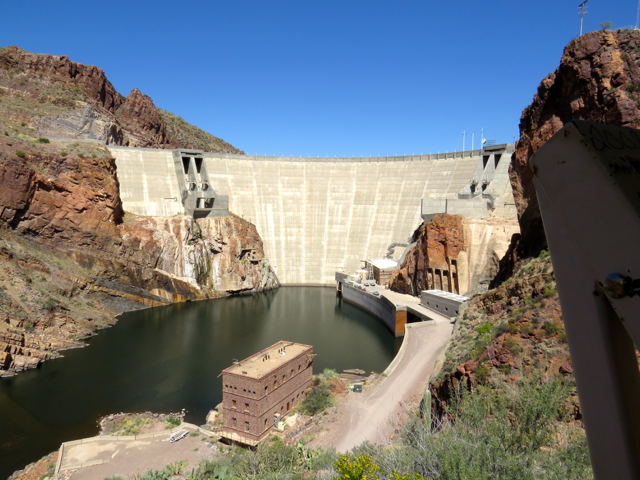
Dam that made the lake.

Dam that made the lake.

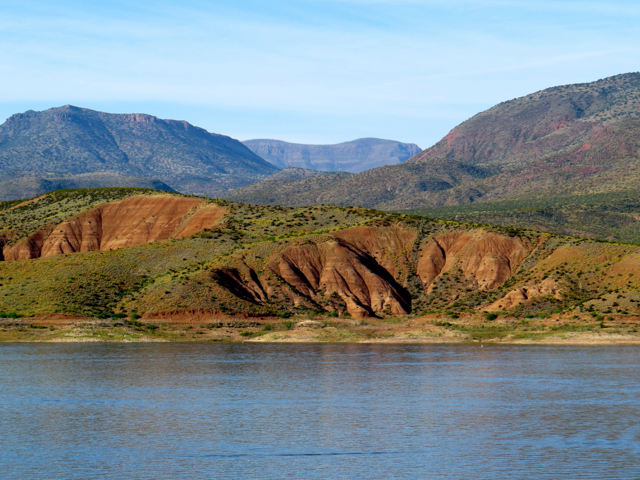
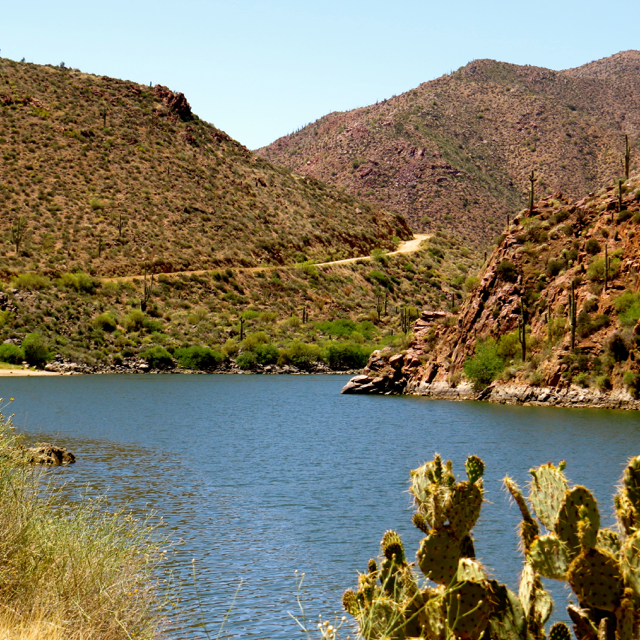
From looking at maps I realized Roosevelt lake is an artificial lake that was made when they put a dam up on the Salt River. One day we went to see the dam and traveled the Apache Trail which was a windy dirt road that runs through the mountains along the salt river. Indeed it was a true path that the Apache used to travel and was utilized by the builders of the dam to bring materials in from Phoenix. Tonto basin, where the Salt River flowed was home to several groups of native people as well as white farmers who came later to the valley. The problem was that every few years the river would flood, wiping out all of the crops and farmland. In order to tame the river the government decided to build a dam and created Roosevelt lake.

Back side of the dam.

Back side of the dam.

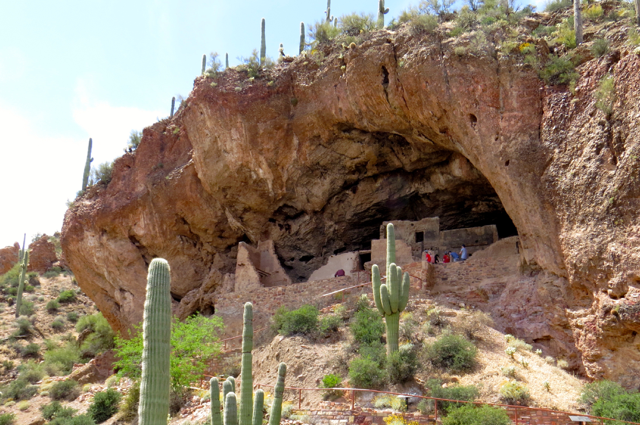
What I didn’t know about this area is that there are many cliff dwellings scattered among the mountains. They were discovered in 1906 when work began on the dam. The Salado people (named by white man after the river, Salado is salt in Spanish) grew their crops in the valley and you could see outlines of irrigation ditches before they flooded the valley. The cliff dwellings are miles from what would have been farmland so it is uncertain whether they also had some type of home or shelter near the fields. They also would have had to carry water very far, I saw no spring or water near the dwellings. I asked a Ranger and they said there was a spring on the other side of the mountain opposite the dwellings. My estimate; two miles one way – up and down a mountain!

Cliff dwellings of the Salado People.

Cliff dwellings of the Salado People.

It was a special experience to be able to walk up to these dwellings and visit them. I loved the way the opening was to the south to let the light in and how integrated the structures were with the surrounding landscape. It was a very hot day and yet it was cool inside. One could sit quietly in the shade and ponder about the lives of the builders of these dwellings. Something that I hadn’t thought about before is that the climate of the desert preserves artifacts much better than in other parts of our country. We are very fortunate to have these places to study, in my opinion it gives us a richer and deeper view of what America truly is.

Partial wall and beams from the dwellings.

Partial wall and beams from the dwellings.

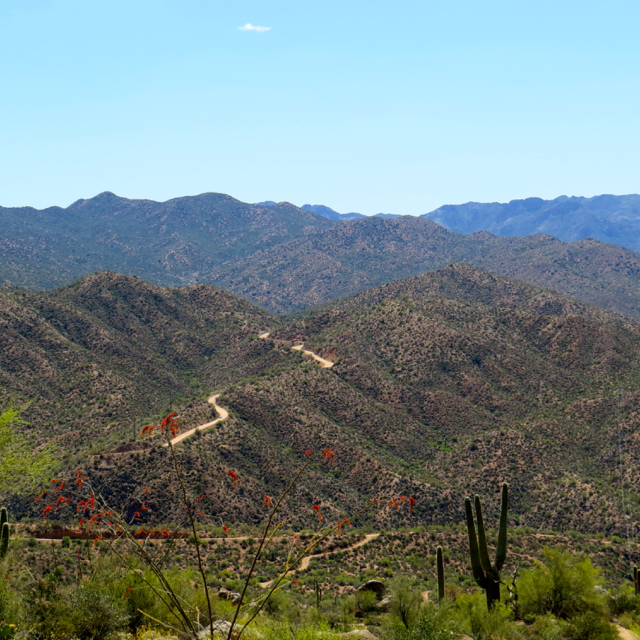
The Salt River with the Apache trail winding above it.

The Salt River with the Apache trail winding above it.

Another view of the Apache Trail.

Another view of the Apache Trail.

I'm happy kayaking, people kept asking why I had a kayak in the desert.

I’m happy kayaking, people kept asking why I had a kayak in the desert.

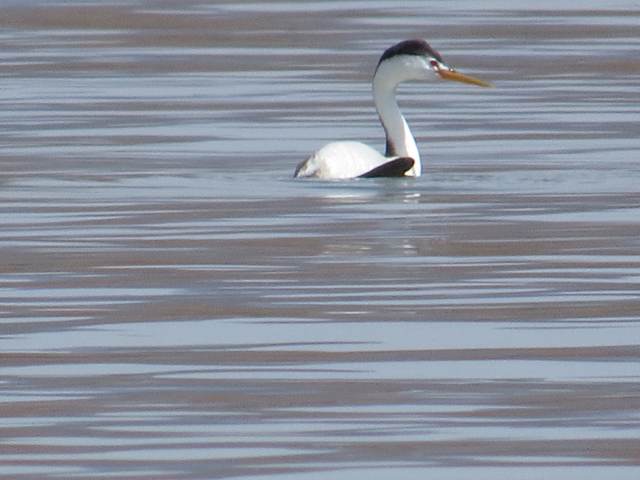
A Clarke's grebe on the lake.

A Clarke’s grebe on the lake.

It's too early for Saguaro Cactus to bloom!

It’s too early for Saguaro Cactus to bloom!

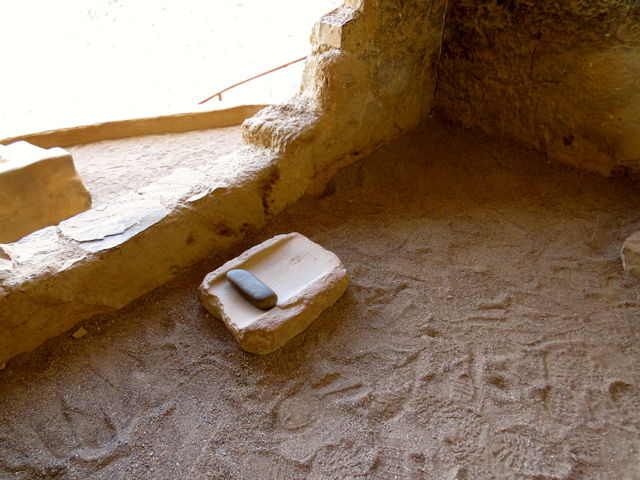
Grinding stone found in the dwellings.

Grinding stone found in the dwell

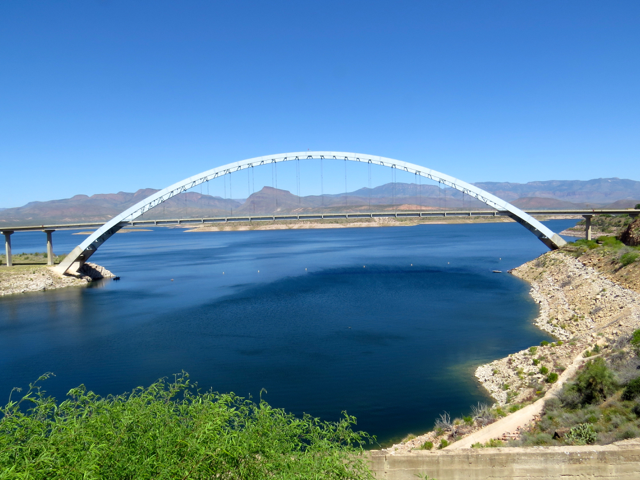
Suspension bridge by the dam.

Suspension bridge by the dam.

Posted in Desert, Historic Places, Lakes | Tagged , , , , , , | 7 Comments

Chuckwallas and Cactus Blooms

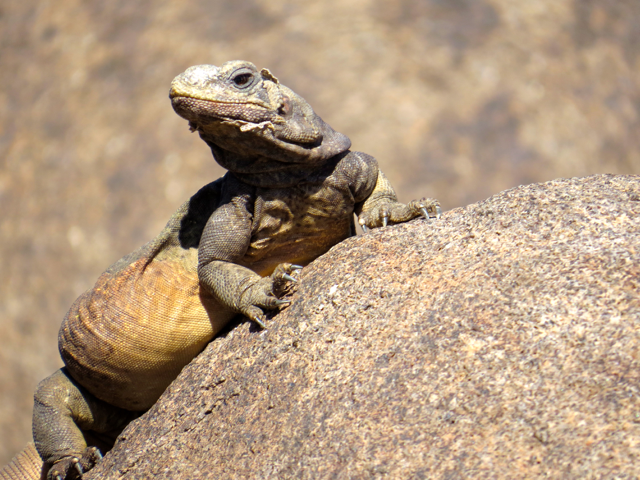
A Chuckwalla

A Chuckwalla

I was reading the guest book at Painted Rocks monument and a young boy had commented that he saw a chuckwalla! What a fun word to say, I practiced rolling it off my tongue for awhile before looking up what a chuckwalla was on my phone. It turn’s out that a chuckwalla is a large lizard that lives in the Sonora desert.

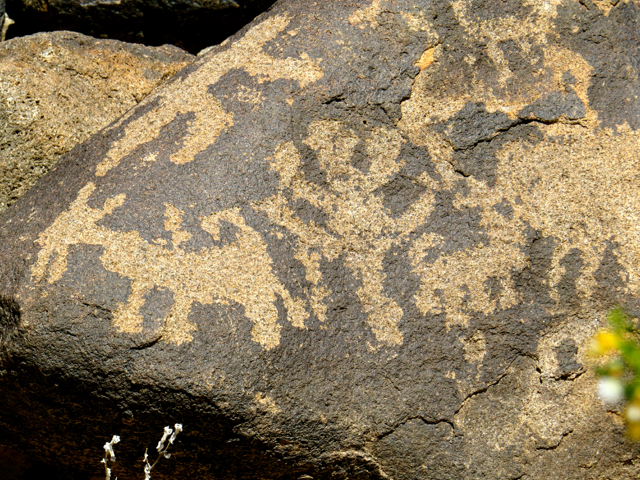
I hiked around the petroglyphs and found several drawings of a chuckwalla, he is a popular fellow to depict! This is what I thought the young man was writing about in the guest book. Then turning the corner I found several real ones posing in the sun! They aren’t skittish like the small lizards which zip around the desert in terror of  roadrunners or snakes. Being almost a foot long, this guy was quite confident he wasn’t going to be dinner! If Mr. Chuckwalla had only known that I was pondering what roasted lizard might taste like he might not have looked so smug.

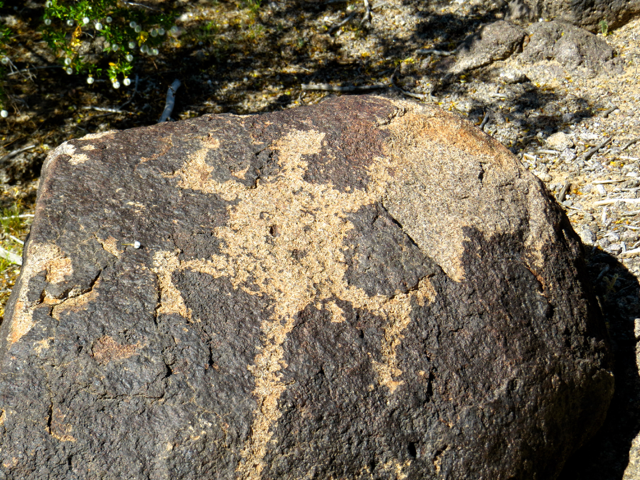
A petroglyph of a Chuckwalla in the Gila style.

A petroglyph of a Chuckwalla in the Gila style.

The site was really interesting and raised many different questions. When approaching it, the place looks like a large mound of dark rocks. I read from the information at the site that these rocks are covered with a volcanic varnish, if you chip the varnish away you uncover the real color of the rock below which is tan.  This makes it possible to scratch pictures in the rocks.

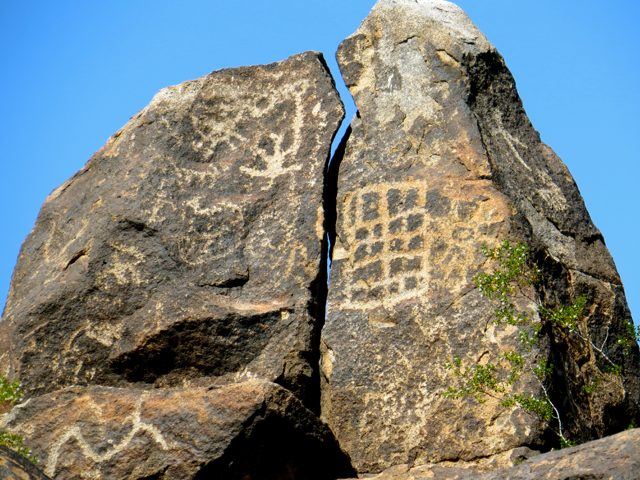
The information at the site also told me that the site is very old with styles from two different cultures. The older culture were hunters and gatherers that lived in this land from 7500 B.C. to AD 1. They had an abstract geometric style with elements of circles, zig zags and grids. The other group of people came later, from 300 BC to AD 1450. They were farmers whose style was known as the Gila style and they carved animals, insects, humans and plants.

Painted Rocks Site

Painted Rocks Site

What amazed me was that large rocks were covered with symbols, no space was empty. It made me wonder why this site was so special, there are rocks with varnish, suitable for carving, all over the desert here but the people came to this one spot to make their symbols. It’s fun to speculate but in the end we can never know the real meaning of these marks, we can only admire the images left behind.

Lots of creatures on these rocks, I think I see a mountain goat!

Lots of creatures on these rocks, I think I see a mountain goat!

The grid on the large rock might be the Western Archaic style.

The grid on the large rock might be the Western Archaic style.

Organ Pipe Cactus National Monument

Organ Pipe Cactus National Monument

Before visiting Painted Rocks I camped for two weeks at Organ Pipe Cactus National Monument. This park is located right on the border between Arizona and Mexico and you have to pass through border patrol to get in. I was amazed at the amount of resources in the way of humans, vehicles, horses, dune buggies, dogs and even helicopters that are concentrated there. Going North one must pass through two additional federal checkpoints besides the one at the border. Since I am not familiar with border patrols  I wonder if this is just a particularly popular spot for people to try a cross illegally or if this is standard for all border crossings.

These exquisite blooms where on a very small cactus.

These exquisite blooms where on a very small cactus.

Everything was in bloom at Organ Pipe, it was a lush garden in the desert. The Palo Verde trees I spoke of in my last post where bursting with yellow flowers. The cactus had all begun blooming. My favorite was the ocotillo plant, at the end of each tall branch was a spray of bright red flowers that the hummingbirds loved. The flowers smelled so sweet they perfumed the evening air.

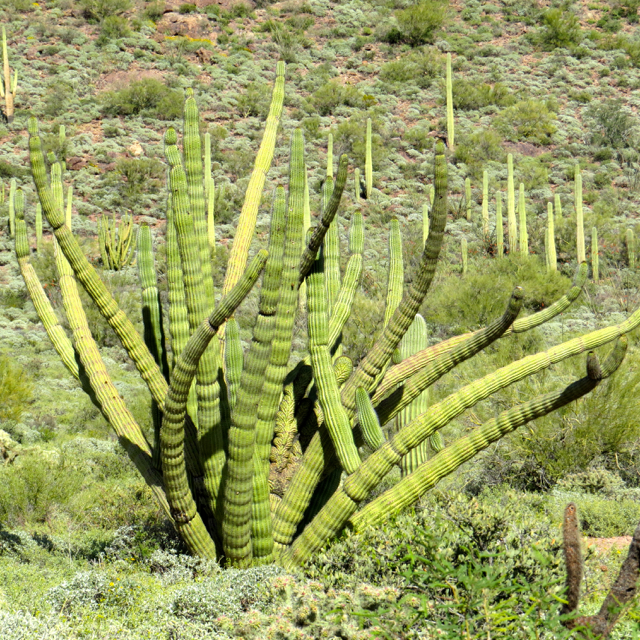
Organ Pipe Cactus have many different arms unlike a Saguaro Cactus.

Organ Pipe Cactus have many different arms unlike a Saguaro Cactus.

The park is so named after the Organ Pipe cactus which only grows in this one spot in the United States. Unlike the Saguaro cactus which grow here as well, the Organ Pipe cactus can not take any freezing temperatures at night. The park is a large flat plain between two mountain ranges. One afternoon Maya and I took a ride through the mountains. Many, were ancient volcanic cones. The land is also carved out into washes, dry beds that water rages through during the wet season in August and September. I find it ironic that a place that has such little water is so dramatically affected by the water when it finally does come. I hope one day I can see one of these washes transformed during a heavy rain.

Maya seemed to be dragging a bit and I felt the warm temperatures were probably getting to her, it was in the high 90’s at Painted Rock. I am searching for a cooler campsite with possibly a lake so Maya can swim and I can Kayak. I will write again soon!

This slideshow requires JavaScript.

Posted in Desert | Tagged , , , , , | 8 Comments

Springtime in the Desert

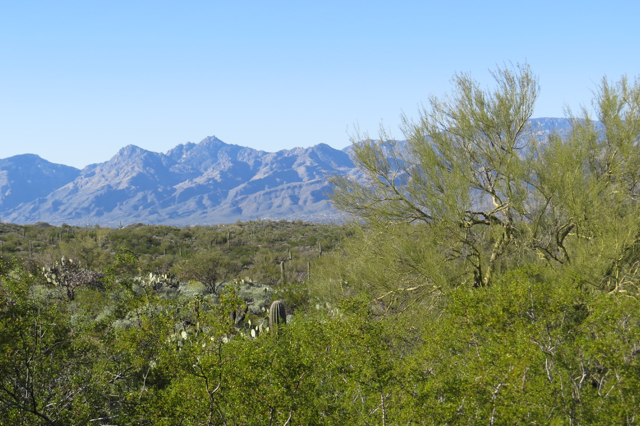
The Sonora Desert

0 The Sonora Desert

IMG_4948

Late last Autumn, I was camping at Catalina State Park, AZ, when I decided to go back to New York for the holidays. Friends of mine in Tucson graciously offered to keep my camper on their property until I returned.

Seeing friends and family at home was wonderful but by February I had enough of winter! Maya and I headed back to Tucson through all types of interesting weather and arrived here on February 26th. Just when spring is coming to the desert.

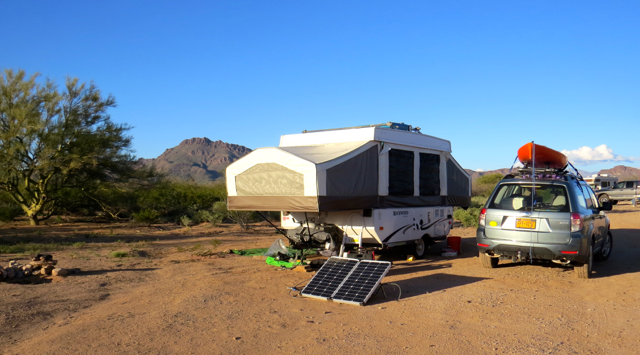
We decided to try boondocking on BLM (Bureau of Land Management) land just south of Tucson. Camping is allowed on these parcels of land in the west and usually there is no fee or a very small fee. There are also no services – no picnic tables, electricity, garbage disposal, bathrooms or water. Not a problem though, you just have to arrive prepared! As I come to the end of my first boondocking experience I have to say I really enjoyed it, I had a beautiful campsite, lots of company and the price was certainly right!

My camper at the site.

My camper at the site.

Spring is beautiful here! Daytime temperatures are in the low 70’s and the nights are between 40 and 50 degrees. It rained one day when we were here and after that rain the desert just exploded with flowers. Birds have been very active too. I listen to owls calling to each other every night and watch hummingbirds at my feeder. I also have a pair of Gila Woodpeckers who like the feeder. A flock of Gambel’s quail frequents the campsite and I’ve spotted a road runner several times but like the poor Wiley coyote I have been unsuccessful at capturing him (on film).

Gila Woodpecker

Gila Woodpecker

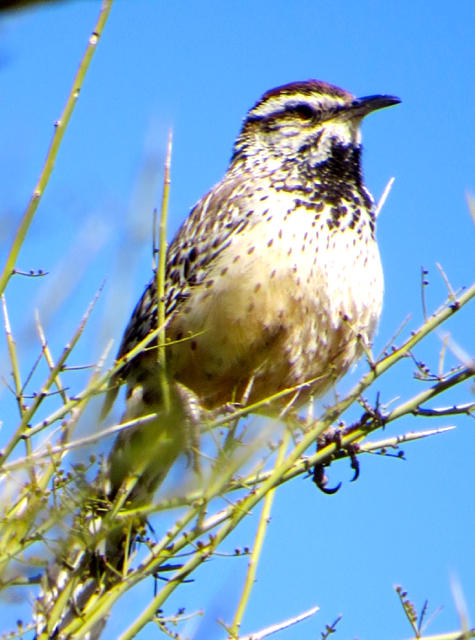
Cactus Wren

Cactus Wren

Saguaro National Park is in the Tucson area and it has two sections, one on the east side of Tucson and one on the west. The parks help remind us that the desert is far from being a dry wasteland but an area teeming with life that has evolved to withstand the heat and lack of water. It’s also a beautiful land with light like no other place. The mountain by my campsite changes in character depending on what time of day it is. On the mountains around the park you see Saguaro Cactus marching up the hills instead of trees!
Many birds make their homes in the cavities.

Many birds make their homes in the cavities of the cactus.

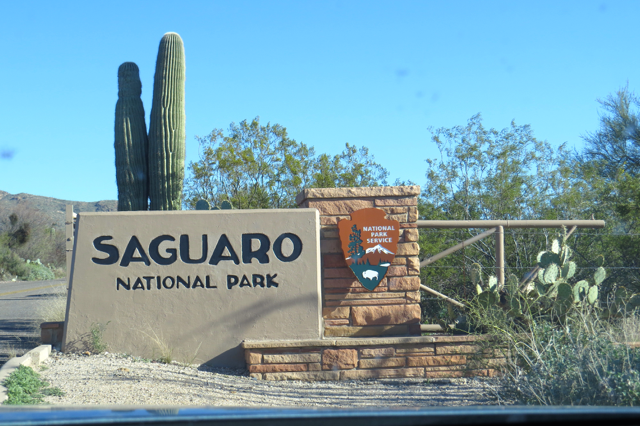
Behind the sign you see a wonderful example of Saguaro Cactus. They can live to be over one hundred years old.

Behind the sign you see a wonderful example of Saguaro Cactus. They can live to be over one hundred years old.


Another valuable resource for understanding the desert is the Arizona-Sonoran Desert Museum, desertmuseum.org , located in Tucson. I had an opportunity to visit it in the fall and loved the hummingbird house, cactus gardens and raptor show. I recommend this museum to anyone visiting this area, young or old! Many of the animals that live in the desert are hard to experience since they are active at night. This museum gives you a chance to experience them in their own beautiful habitat.

Two Harris Hawks I saw during the raptor show at the desert museum.

Two Harris Hawks I saw during the raptor show at the desert museum. They are sitting on the shell of a dead Saguaro cactus.

IMG_4868

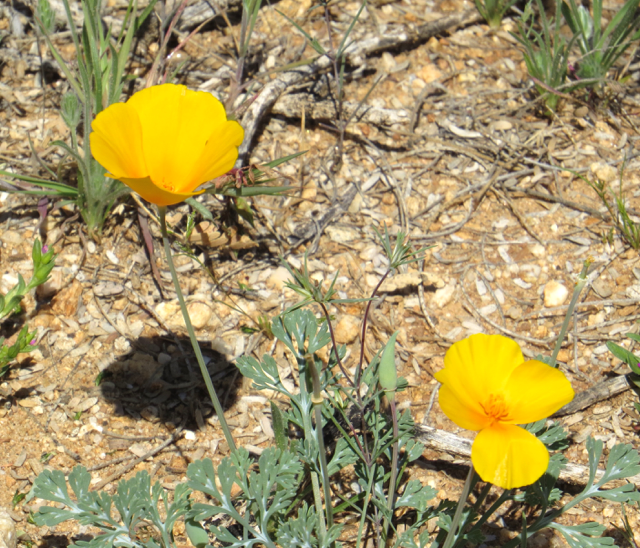
I’m not sure what kind of flower this is but it was beautiful!


Poppies

Poppies


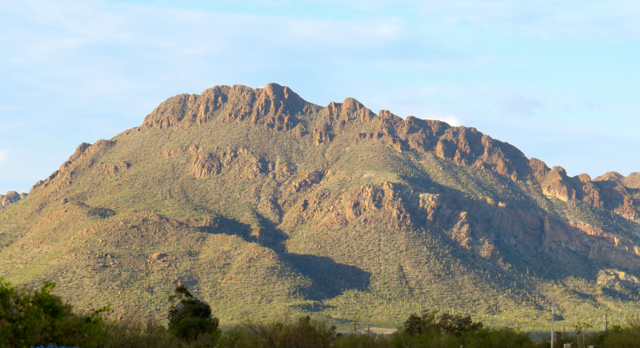
This is the mountain by the campsite during the day, watch how it changes in the evening light.

This is the mountain by the campsite during the day, watch how it changes in the evening light.

Same mountain in the evening.

Same mountain in the evening.

My campsite had a Palo Verde tree for shade. They have very small leaves and grow near washes.
My campsite had a Palo Verde tree for shade. They have very small leaves and grow near washes.

This is the bark of the tree, it's green so it can help produce food through photosynthesis.

This is the bark of the tree, it’s green so it can help produce food through photosynthesis.

I’m leaving Tucson in another day or two for Organ Pipe Cactus National Monument. This area is west of Tucson in a remote area on the border of Arizona and Mexico. I am a little amazed that this ocean girl loves the desert so much, where water is so very scarce and very precious.

Posted in boondocking, Desert | Tagged , , , , | 5 Comments

First Impressions, Part Two

IMG_3838

Dear Reader, this is the second part of a two-part series called First Impressions. I have been thinking about how your first experience in a new place shapes your further adventures there and I wanted to write about two different experiences upon entering National Parks. For me both where dramatic entrances which left a lasting impression. This second part is upon entering Joshua Tree National Park.

Azalea campground in Kings Canyon National Park was one of my favorite campgrounds on this trip so it was understandable that I might be dragging my feet a bit when it was time to leave. I also had mixed emotions about visiting the desert – I have always been such a water person, what would the desert be like for me? It was a combination of these two reasons that gave me such a late start when traveling to Joshua Tree National Park which is located in the Mojave desert in California.

I drove all afternoon through the San Joaquin Valley and reached the Mojave Desert just before sunset.  Although the incredible color of the sunset began in the west there was also brilliant color in the east. The Mojave is a high desert and at sunset I felt as if there was a large bowl over my head swirling with color that was so bright I wanted to take a bite out of it. Then I noticed on the eastern horizon a band of deep ultramarine blue just after the color. As dusk progressed this band of blue began to cover the sky like an evening shawl, tucking the earth in for another peaceful sleep.

In the east you can see the blue mantel of evening beginning to appear on the horizon.

In the east you can see the blue mantel of evening beginning to appear on the horizon.

I continued on to Joshua Tree in the dark. The last of this year’s super moons was almost full so it lit up the landscape for me. As I entered the park I checked which campgrounds had space and continued on. Joshua Trees have been described as Dr. Seuss trees and in the moonlight this was certainly true. I passed through forests of them, their silhouettes showing branches akimbo with a sharp bouquet at the end of each branch. There were jagged mountains in the distance, a lone coyote passed in front of my car and everything was so quiet.

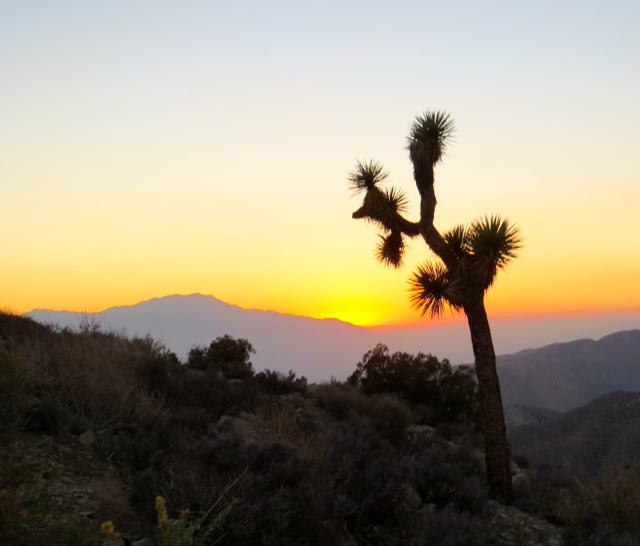
Every Joshua tree has a strange and unique shape. Some are up to forty feet tall.

Every Joshua tree has a strange and unique shape. Some are up to forty feet tall.


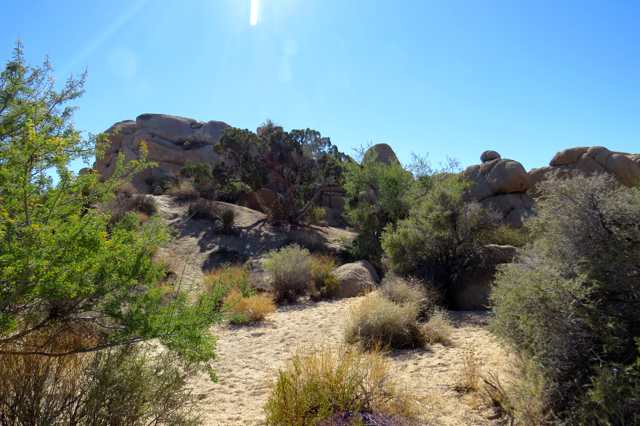
Around a corner the landscape suddenly changed from flat desert and trees to large rounded rocks. A sign for Jumbo Rocks Campground came into view. I liked the name of the place so I pulled in and was amazed! This landscape was dominated by huge piles of boulders piled up everywhere – the campsites were nestled into corners and crags of the piles. It was Friday night and everyone was up and had a fire going. The fires cast strange shadows onto the boulders. My car windows were down and I heard a cacophony of different languages and music coming from many of the campsites. I felt as if I had landed on Luke Skywalker’s home planet, Tatooine. There was a feeling of energy in the air as the day’s heat evaporated with the dark.

My own private rock garden.

My own private rock garden.

I found a beautiful campsite which had it’s own private rock garden in the yard, the moon was so luminous I didn’t need much additional light to set up the camper. I went to bed very excited to explore my new surroundings in the desert. I am left wondering if it was the positive first impression of Joshua Tree National Park which has made it one of my favorite parks or if my first experience was different would have felt the same anyway?

This slideshow requires JavaScript.

Posted in Desert | Tagged , , , , | 3 Comments

First Impressions, Part One


Group of Sequoias of different stages of growth.

Group of Sequoia of different stages of growth.

Dear Reader, this is the first part of a two-part series called First Impressions. I have been thinking about how your first experience in a new place shapes your further adventures there and I wanted to write about two different experiences upon entering National Parks. For me both where dramatic entrances which left a lasting impression.

There are two entrances to Kings Canyon and Sequoia National Parks but to reach either you must pass through the San Joaquin Valley in California. For an Easterner this is an odd place, agriculture is the main industry here yet this is an arid land, all that grows is done with the magic of irrigation. Peaches, plums, oranges, olives, grapes and sun loving vegetables were all crops I passed along the way. But anywhere there wasn’t farm land was dry brush and prickly pear cactus. I saw canals that bring the water to the farms and passed billboards urging people to vote for the politician who favored the farm canals. The drought here is clearly a big issue. I began to worry, when I visited Redwood National Park I learned about the moisture requirements for Redwood trees. It made sense to me that they grew only along the rainy, foggy Northern Pacific Coast of California and the Southern Pacific Coast of Oregon. How could the huge Sequoia survive in a climate like this?

Yucca Plants

Yucca Plants

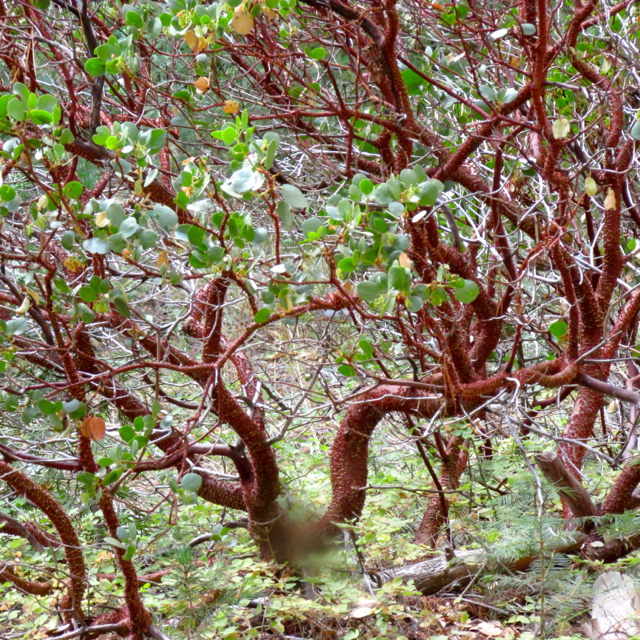
Manzanita bushes have beautiful crimson branches with green leaves.

Manzanita bushes have beautiful crimson branches with green leaves.

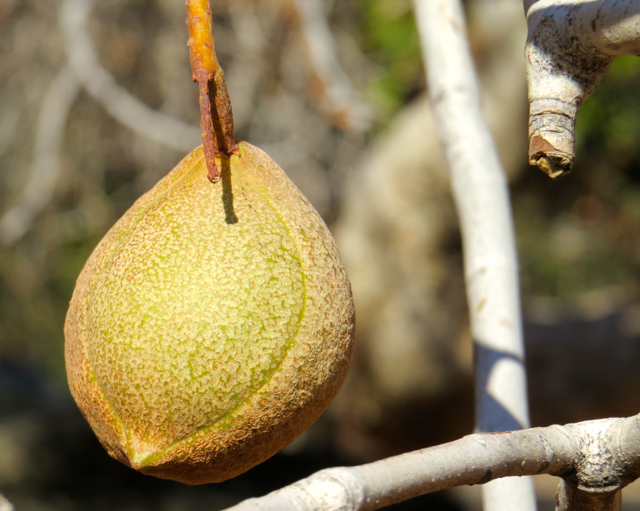
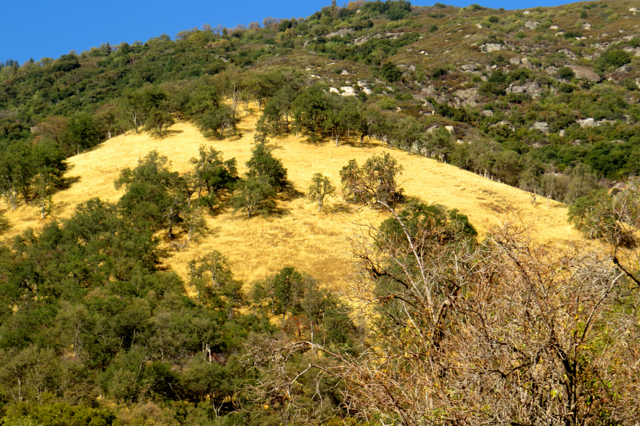
The foothills I drove through to get to the entrance were covered with a dry golden grasses. Yuccas and Prickly Pear Cactus grew everywhere. I felt I was on the wrong road – how could this be the road to a forest that held one of the oldest and largest living trees on Earth? The vegetation here had clearly adapted to the ferocious heat. No stately trees but dried grasses, small mean scrub bushes, cactus and succulents. After the park entrance things became drier, I stopped at Potwisha Picnic area to explore a little. There is an odd tree that has a pear-like fruit on it. It has lost all it’s leaves, they have dried right on the tree and blown away – but the fruit was left behind. Would these trees come back to life in the spring? Was this a  normal growth pattern, or something that had happened  because of the drought? I never got an opportunity to ask a ranger so I’m still wondering.

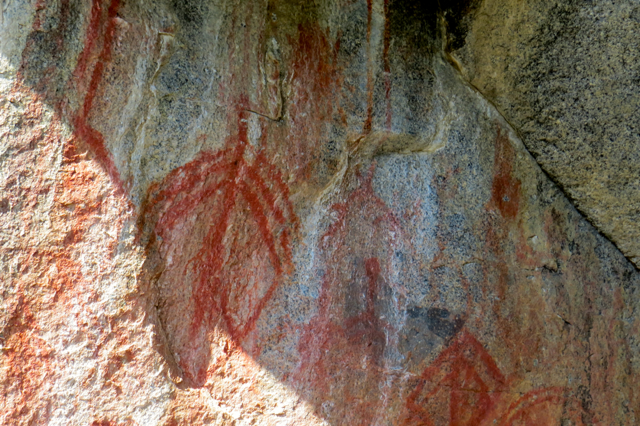
Also at Potwisha was a large rock called Hospital Rock that had petroglyphs left from the Potwisha Indians that lived here hundreds of years ago. I love these symbols because making marks and telling stories is what makes humans unique. We don’t only want to live in the moment, we have a need to leave something of ourselves behind after we are gone. I spent some time studying the petroglyphs before I continued my journey to Sequoia. The paint had started to run down the rocks making them hard to see in areas but others were still fairly clear. Although we can never know the true meaning of these pictures it is fun to speculate what they might have been saying.

These trees had lost their leaves but the fruit still hangs on them.

These trees had lost their leaves but the fruit still hangs on them.

This is what the fruit looked like.

This is what the fruit looked like.

After Potwisha the road became a challenge! The state of California saves millions of dollars on road work by not putting up guard rails. I’ve been to a number of places in this state now with windy, twisty, narrow roads that climb to incredible heights and none of them have guard rails – Californians just don’t believe in them! The road up to Sequoia was one of these roads, filled with hairpin turns and switchbacks; they would periodically have a sign to let you know what altitude you were at, as if my ears hadn’t already told me I was way too high and if I climbed any more my eardrums might burst! The scenery was spectacular but because I was concentrating so hard on my driving – (did I mention I’m afraid of heights? )  I could only enjoy the view at the pull-outs.

An example of one of the petroglyphs.

An example of one of the petroglyphs.

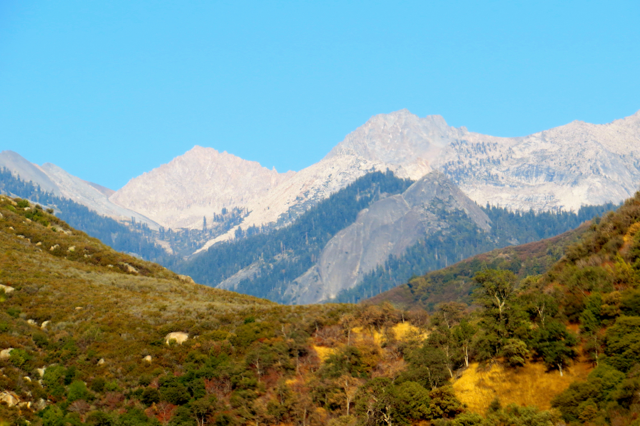
In these foothills you could begin to see the Sierra Nevada Range of mountains peeking over the top. These mountains were granite rock, well above the tree line. Stately and majestic as they were, I still wondered where, oh where, were my Sequoia?  I  worried because it was still so very, very dry. At about 4,000 feet (thanks, elevation sign) there began to be deciduous trees. They were well spaced with golden grass growing under them. I thought this might be so so each tree could get it’s water requirement.           

Golden meadows with a scattering of trees.

Golden meadows with a scattering of trees.could get it’s water requirement.

Gradually we climbed higher and the forest became more dense. We pulled out frequently and stopped to search for any tall trees. The temperature at Potwisha had been 92 degrees. It was now about 78 degrees. At 5,000 feet there became a smattering of evergreen trees, Incense Cedar and Lodgepole Pine. The road was also starting to straighten out a bit. Six thousand feet and the forest became dense and cool, no more deciduous trees, only evergreens. I stopped once more and looked down, I couldn’t believe how far we had come. Looking down you could see the scope of the journey. It was incredible how the view had carefully unfolded little by little as we journeyed upward. Each turn was a new surprise.

Looking down on one of the hairpin turns I had just traveled up.

Looking down on one of the hairpin turns I had just traveled up.

A glimpse of the Sierras

A glimpse of the Sierras

At almost 7,000 feet, without warning I was suddenly among the Sequoia; I felt like a mouse under an elephant’s legs. They were massive, the trunks a beautiful bright cinnamon color. The bark was grooved and twisted from a thousand years or more of weather and wind and fire. The pines around them were large for their species but dwarfed when compared to the Sequoia. I stopped,and got out of the car to explore. It was cool (65 degrees) and peaceful there. The light filtered through the trees and there were rustling forest sounds as I studied the trees. Many had huge burn scars and holes where all sorts of creatures lived. When you felt the bark it felt soft and almost spongy. The Sequoia had delicate, feathery needles at the end of twisting branches that reach for the sky. Their cones are amazingly small for such a large tree – smaller than a chicken egg. I leaned against them and gazed up at the clear blue sky through their branches and felt as rooted to the earth as they where. I don’t know why but I felt safe in this giant forest.

A beautiful group of Sequoias.

A beautiful group of Sequoia.

Looking up through the branches.

Looking up through the branches.

This slideshow requires JavaScript.

Posted in mountains | Tagged , , , , | 2 Comments