
Group of Sequoia of different stages of growth.
Dear Reader, this is the first part of a two-part series called First Impressions. I have been thinking about how your first experience in a new place shapes your further adventures there and I wanted to write about two different experiences upon entering National Parks. For me both where dramatic entrances which left a lasting impression.
There are two entrances to Kings Canyon and Sequoia National Parks but to reach either you must pass through the San Joaquin Valley in California. For an Easterner this is an odd place, agriculture is the main industry here yet this is an arid land, all that grows is done with the magic of irrigation. Peaches, plums, oranges, olives, grapes and sun loving vegetables were all crops I passed along the way. But anywhere there wasn’t farm land was dry brush and prickly pear cactus. I saw canals that bring the water to the farms and passed billboards urging people to vote for the politician who favored the farm canals. The drought here is clearly a big issue. I began to worry, when I visited Redwood National Park I learned about the moisture requirements for Redwood trees. It made sense to me that they grew only along the rainy, foggy Northern Pacific Coast of California and the Southern Pacific Coast of Oregon. How could the huge Sequoia survive in a climate like this?

Yucca Plants
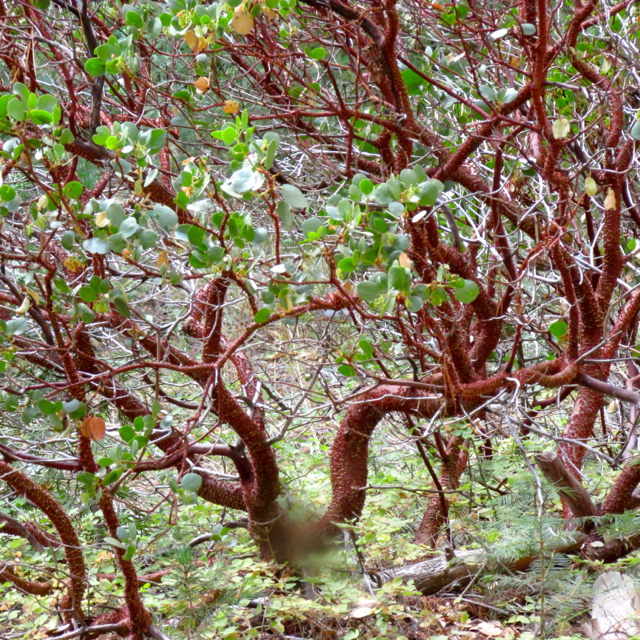
Manzanita bushes have beautiful crimson branches with green leaves.
The foothills I drove through to get to the entrance were covered with a dry golden grasses. Yuccas and Prickly Pear Cactus grew everywhere. I felt I was on the wrong road – how could this be the road to a forest that held one of the oldest and largest living trees on Earth? The vegetation here had clearly adapted to the ferocious heat. No stately trees but dried grasses, small mean scrub bushes, cactus and succulents. After the park entrance things became drier, I stopped at Potwisha Picnic area to explore a little. There is an odd tree that has a pear-like fruit on it. It has lost all it’s leaves, they have dried right on the tree and blown away – but the fruit was left behind. Would these trees come back to life in the spring? Was this a normal growth pattern, or something that had happened because of the drought? I never got an opportunity to ask a ranger so I’m still wondering.
Also at Potwisha was a large rock called Hospital Rock that had petroglyphs left from the Potwisha Indians that lived here hundreds of years ago. I love these symbols because making marks and telling stories is what makes humans unique. We don’t only want to live in the moment, we have a need to leave something of ourselves behind after we are gone. I spent some time studying the petroglyphs before I continued my journey to Sequoia. The paint had started to run down the rocks making them hard to see in areas but others were still fairly clear. Although we can never know the true meaning of these pictures it is fun to speculate what they might have been saying.

These trees had lost their leaves but the fruit still hangs on them.
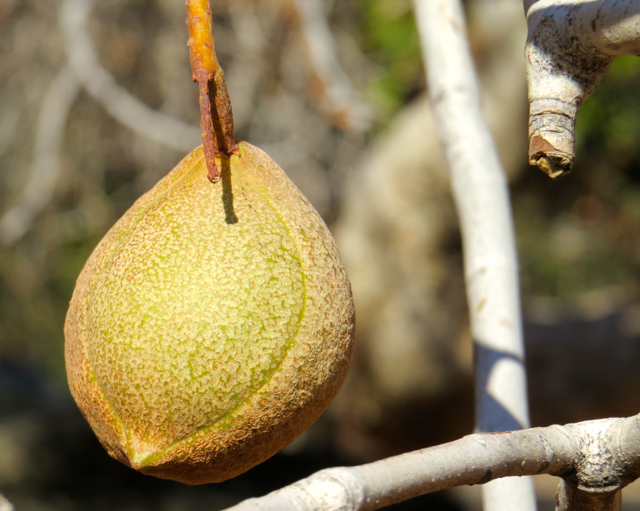
This is what the fruit looked like.
After Potwisha the road became a challenge! The state of California saves millions of dollars on road work by not putting up guard rails. I’ve been to a number of places in this state now with windy, twisty, narrow roads that climb to incredible heights and none of them have guard rails – Californians just don’t believe in them! The road up to Sequoia was one of these roads, filled with hairpin turns and switchbacks; they would periodically have a sign to let you know what altitude you were at, as if my ears hadn’t already told me I was way too high and if I climbed any more my eardrums might burst! The scenery was spectacular but because I was concentrating so hard on my driving – (did I mention I’m afraid of heights? ) I could only enjoy the view at the pull-outs.
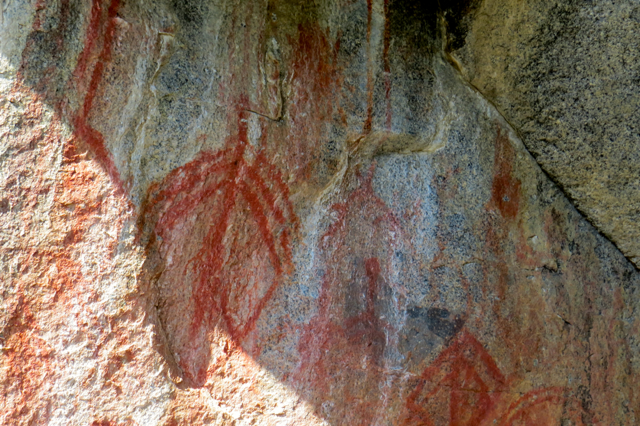
An example of one of the petroglyphs.
In these foothills you could begin to see the Sierra Nevada Range of mountains peeking over the top. These mountains were granite rock, well above the tree line. Stately and majestic as they were, I still wondered where, oh where, were my Sequoia? I worried because it was still so very, very dry. At about 4,000 feet (thanks, elevation sign) there began to be deciduous trees. They were well spaced with golden grass growing under them. I thought this might be so so each tree could get it’s water requirement.
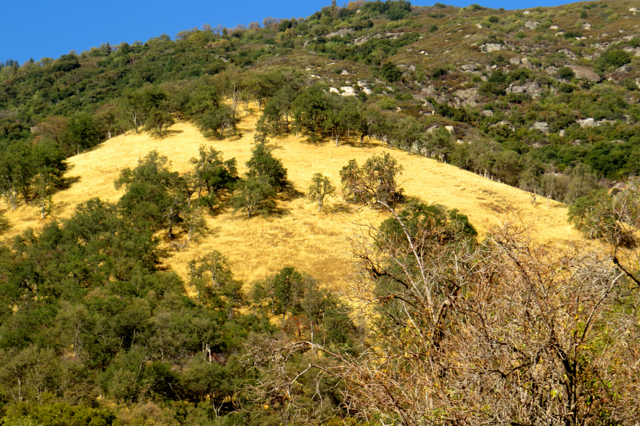
Golden meadows with a scattering of trees.could get it’s water requirement.
Gradually we climbed higher and the forest became more dense. We pulled out frequently and stopped to search for any tall trees. The temperature at Potwisha had been 92 degrees. It was now about 78 degrees. At 5,000 feet there became a smattering of evergreen trees, Incense Cedar and Lodgepole Pine. The road was also starting to straighten out a bit. Six thousand feet and the forest became dense and cool, no more deciduous trees, only evergreens. I stopped once more and looked down, I couldn’t believe how far we had come. Looking down you could see the scope of the journey. It was incredible how the view had carefully unfolded little by little as we journeyed upward. Each turn was a new surprise.

Looking down on one of the hairpin turns I had just traveled up.
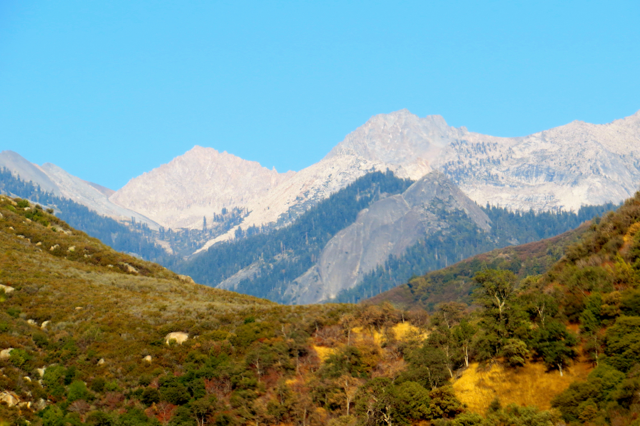
A glimpse of the Sierras
At almost 7,000 feet, without warning I was suddenly among the Sequoia; I felt like a mouse under an elephant’s legs. They were massive, the trunks a beautiful bright cinnamon color. The bark was grooved and twisted from a thousand years or more of weather and wind and fire. The pines around them were large for their species but dwarfed when compared to the Sequoia. I stopped,and got out of the car to explore. It was cool (65 degrees) and peaceful there. The light filtered through the trees and there were rustling forest sounds as I studied the trees. Many had huge burn scars and holes where all sorts of creatures lived. When you felt the bark it felt soft and almost spongy. The Sequoia had delicate, feathery needles at the end of twisting branches that reach for the sky. Their cones are amazingly small for such a large tree – smaller than a chicken egg. I leaned against them and gazed up at the clear blue sky through their branches and felt as rooted to the earth as they where. I don’t know why but I felt safe in this giant forest.

A beautiful group of Sequoia.

Looking up through the branches.


Very ambitious evocation of climbing from the perpetually drought-imperiled produce-growing valley, then up through the foothills, and along hairpin switchbacks into the great mountains. Nice work in the writing. The photos really add a lot of dimension, they draw us in.
(One lil typo you’ll want to edit: Second paragraph: Where it says, “… olives, grapes, and sun-loving vegetables where all crops I passed along the way” ,,, it should be “were all crops I passed along the way.”)
Also, I enjoyed actually viewing the prickly pear: I have been told that I am one. (Sweet on the inside.) — mike