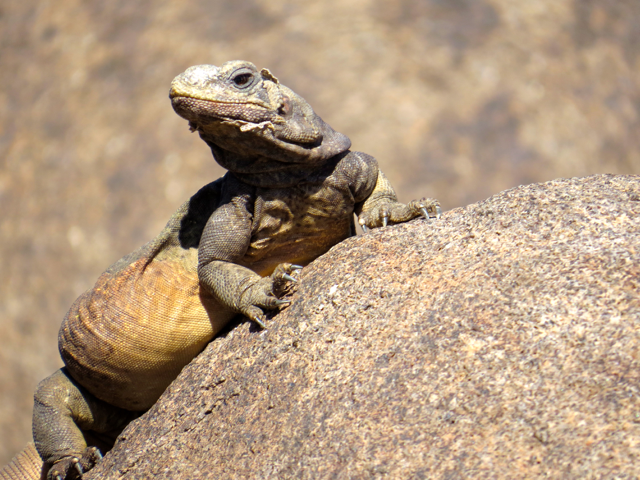
A Chuckwalla
I was reading the guest book at Painted Rocks monument and a young boy had commented that he saw a chuckwalla! What a fun word to say, I practiced rolling it off my tongue for awhile before looking up what a chuckwalla was on my phone. It turn’s out that a chuckwalla is a large lizard that lives in the Sonora desert.
I hiked around the petroglyphs and found several drawings of a chuckwalla, he is a popular fellow to depict! This is what I thought the young man was writing about in the guest book. Then turning the corner I found several real ones posing in the sun! They aren’t skittish like the small lizards which zip around the desert in terror of roadrunners or snakes. Being almost a foot long, this guy was quite confident he wasn’t going to be dinner! If Mr. Chuckwalla had only known that I was pondering what roasted lizard might taste like he might not have looked so smug.
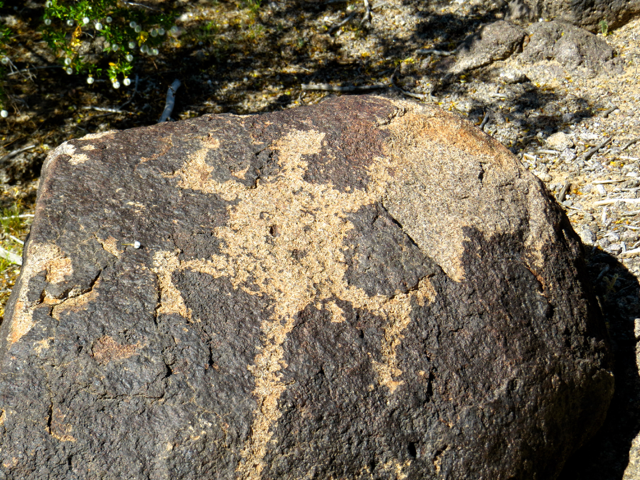
A petroglyph of a Chuckwalla in the Gila style.
The site was really interesting and raised many different questions. When approaching it, the place looks like a large mound of dark rocks. I read from the information at the site that these rocks are covered with a volcanic varnish, if you chip the varnish away you uncover the real color of the rock below which is tan. This makes it possible to scratch pictures in the rocks.
The information at the site also told me that the site is very old with styles from two different cultures. The older culture were hunters and gatherers that lived in this land from 7500 B.C. to AD 1. They had an abstract geometric style with elements of circles, zig zags and grids. The other group of people came later, from 300 BC to AD 1450. They were farmers whose style was known as the Gila style and they carved animals, insects, humans and plants.

Painted Rocks Site
What amazed me was that large rocks were covered with symbols, no space was empty. It made me wonder why this site was so special, there are rocks with varnish, suitable for carving, all over the desert here but the people came to this one spot to make their symbols. It’s fun to speculate but in the end we can never know the real meaning of these marks, we can only admire the images left behind.
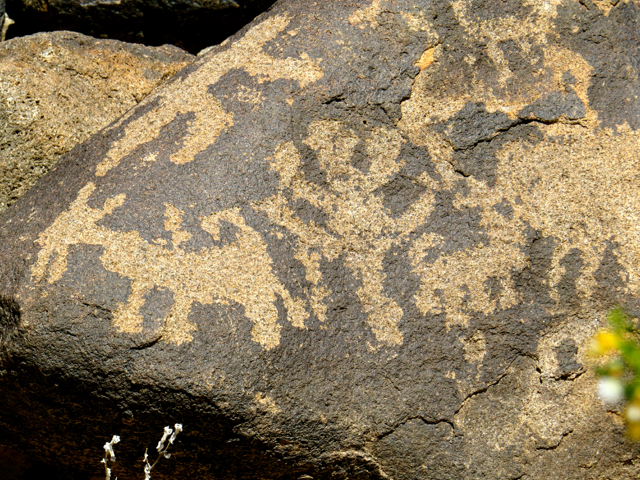
Lots of creatures on these rocks, I think I see a mountain goat!
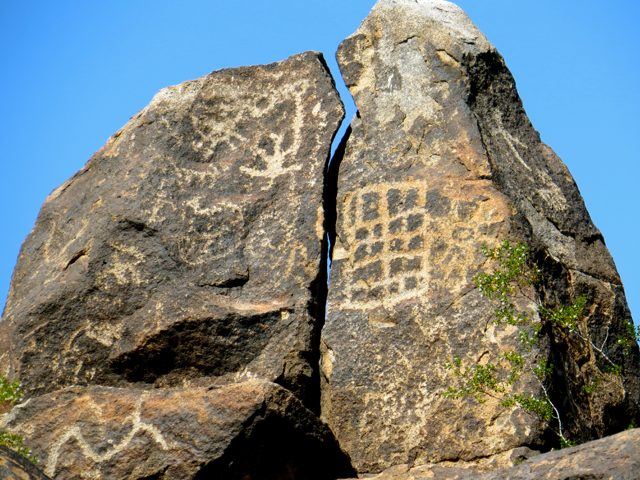
The grid on the large rock might be the Western Archaic style.

Organ Pipe Cactus National Monument
Before visiting Painted Rocks I camped for two weeks at Organ Pipe Cactus National Monument. This park is located right on the border between Arizona and Mexico and you have to pass through border patrol to get in. I was amazed at the amount of resources in the way of humans, vehicles, horses, dune buggies, dogs and even helicopters that are concentrated there. Going North one must pass through two additional federal checkpoints besides the one at the border. Since I am not familiar with border patrols I wonder if this is just a particularly popular spot for people to try a cross illegally or if this is standard for all border crossings.

These exquisite blooms where on a very small cactus.
Everything was in bloom at Organ Pipe, it was a lush garden in the desert. The Palo Verde trees I spoke of in my last post where bursting with yellow flowers. The cactus had all begun blooming. My favorite was the ocotillo plant, at the end of each tall branch was a spray of bright red flowers that the hummingbirds loved. The flowers smelled so sweet they perfumed the evening air.
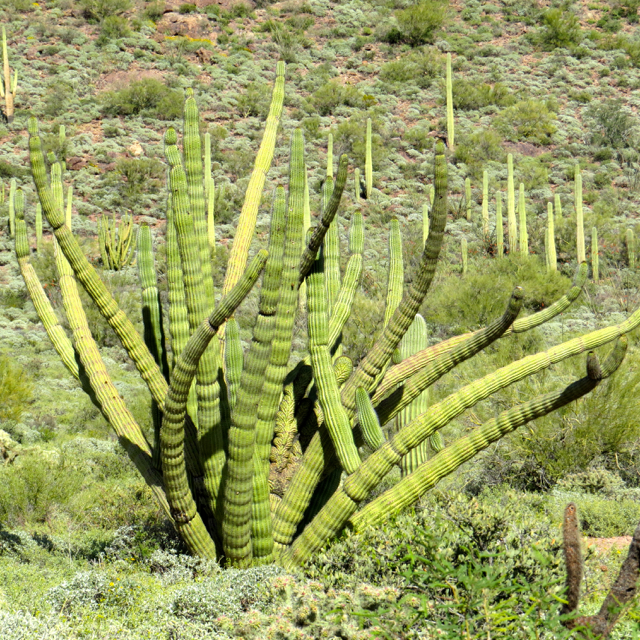
Organ Pipe Cactus have many different arms unlike a Saguaro Cactus.
The park is so named after the Organ Pipe cactus which only grows in this one spot in the United States. Unlike the Saguaro cactus which grow here as well, the Organ Pipe cactus can not take any freezing temperatures at night. The park is a large flat plain between two mountain ranges. One afternoon Maya and I took a ride through the mountains. Many, were ancient volcanic cones. The land is also carved out into washes, dry beds that water rages through during the wet season in August and September. I find it ironic that a place that has such little water is so dramatically affected by the water when it finally does come. I hope one day I can see one of these washes transformed during a heavy rain.
Maya seemed to be dragging a bit and I felt the warm temperatures were probably getting to her, it was in the high 90’s at Painted Rock. I am searching for a cooler campsite with possibly a lake so Maya can swim and I can Kayak. I will write again soon!

 Away!
Away! 
Hi Kathy, I actually bought the pop-up for the trip. I didn’t want to by a truck because of the poor gas mileage they get, I wanted something small my Subaru Forester could tow. I looked at teardrop trailers and scamps but they felt too confining, I like the wide open feel of the large windows the pop-up has. I average 22 miles per gallon towing which is a huge savings! That being said, taking down and putting a pop- up up is a process. I never stay someplace one night, it’s too much work. I travel slowly and usually stay someplace about a week to ten days. An overnight at Walmart would not be possible. The bottom line, it takes about 2 and a half hours to take it all down (I still have a lot of stuff!) and an hour and a half to set back up. I try not to drive any further than 5 hours a day. With that schedule I find things are very manageable. The other drawback with a pop-up is that they are not as secure as a trailer or a mobile home. Although you can lock the door, it’s a joke since you can just rip the side open and unlock it. I’ve never had a problem but also don’t leave valuables in the camper. I hope this helps, if you have any other questions don’t hesitate to ask. Happy hunting!
Hi, Could you tell more about setting up and breaking camp. My understanding is you had the popup camper before you decided on this trip. I’m trying to find an economical way to full time. I’ve been told I wouldn’t want a popup (by persons that don’t own a popup) because it’s so much trouble to set up and take down. Thanks for any info you can give.
I live in the desert …one hour north of Phoenix. Spring in the desert is FABULOUS! Nice pictures on your slideshow! Oh and even though the teddy bear cholla is “cute… they are evil. They jump and grab you and are very hard to get out. Great post! 😀
Thanks for the comment Nancy. Lucky you to live in the desert, Arizona is stunning in the spring, I really enjoyed visiting.
I love the “Teddy Bear Cholla.” Who Knew? The cactus flower slide show is great. Very good posts from the desert. – Mike
Teddy Bear Cholla are also called jumping cactus because it’s very easy to get them stuck on you.
Fantastic post, as always. Enjoy! xoxo
Thanks Anne! And thank you for taking the time to comment.